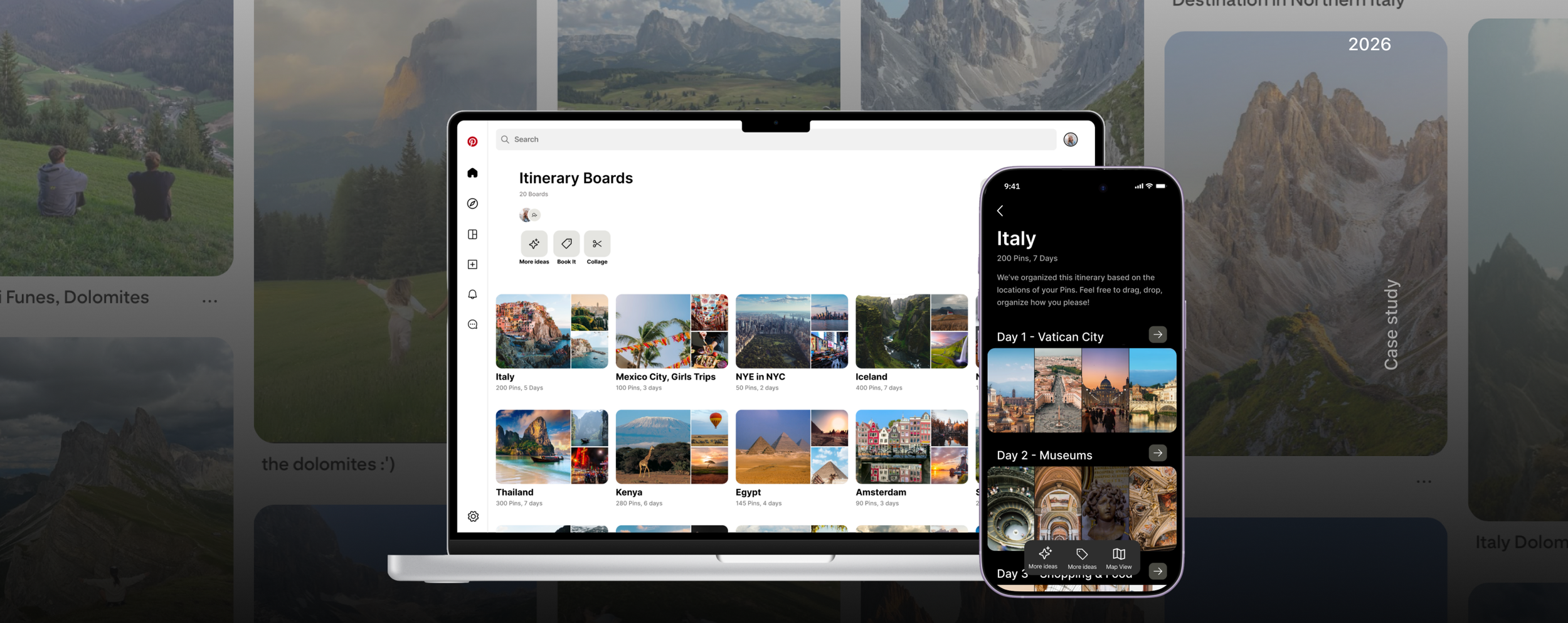
Pinterest: Itinerary Boards
Pinterest is a go-to hub for early-stage travel inspiration—many users save Pins of lakeside hikes, cliffside resorts, river tubing, and dreamy camping trips vibes. But when trying to uncover where these stunning pictures were taken, the trail often goes cold. Without geo-tags or map-based browsing, users must investigate comment sections, or manually investigate across multiple platforms, breaking flow and slowing planning. Meanwhile, travel boards remain static collections of mystery images rather than dynamic, actionable itineraries.
Despite there being “1 billion travel searches annually… and 8 in 10 weekly users rely[ing] on Pinterest for trip planning,” the lack of location context results in lost user engagement, fragmented workflows, and missed opportunities for monetization. With user problems spanning from decision paralysis to fragmented tools, Pinterest has an opportunity to unify inspiration and planning through AI-powered geo-tagging and map-view discovery, which would then unlock inspiring itinerary generation.
Problem #1: Inspiration Overload & Decision Paralysis
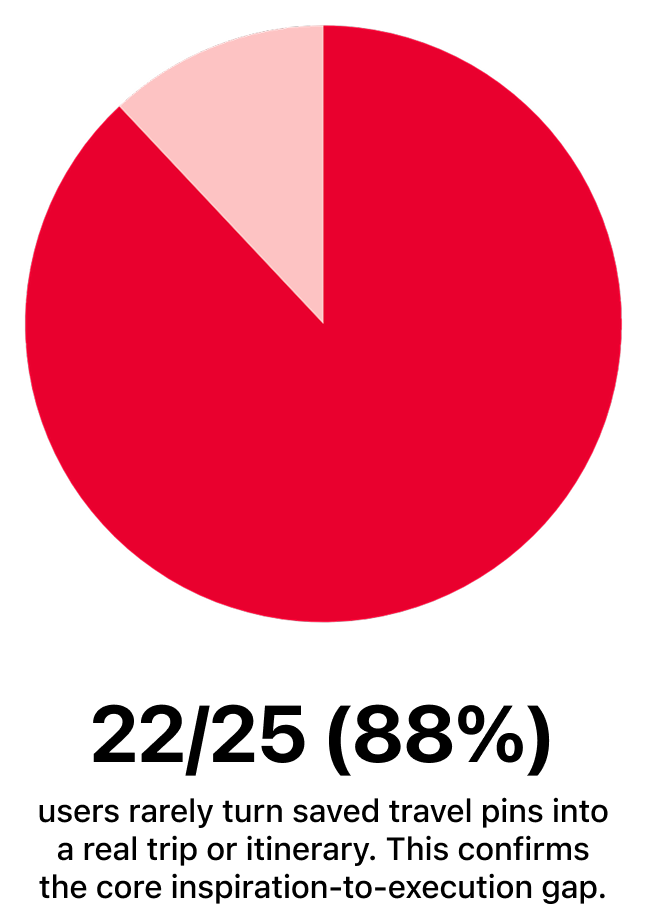
Gen Z and Millennial travelers save hundreds of destinations, restaurants, and activities across social media, but turning that inspiration into a cohesive itinerary is often overwhelming.
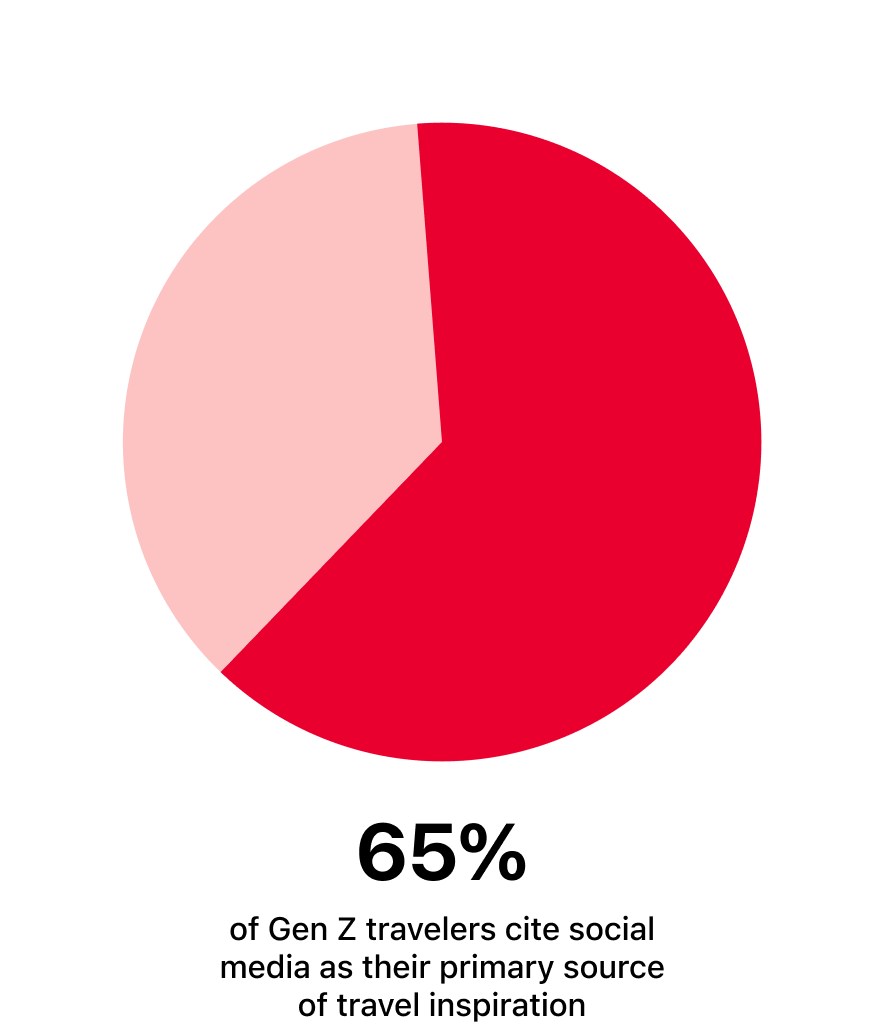
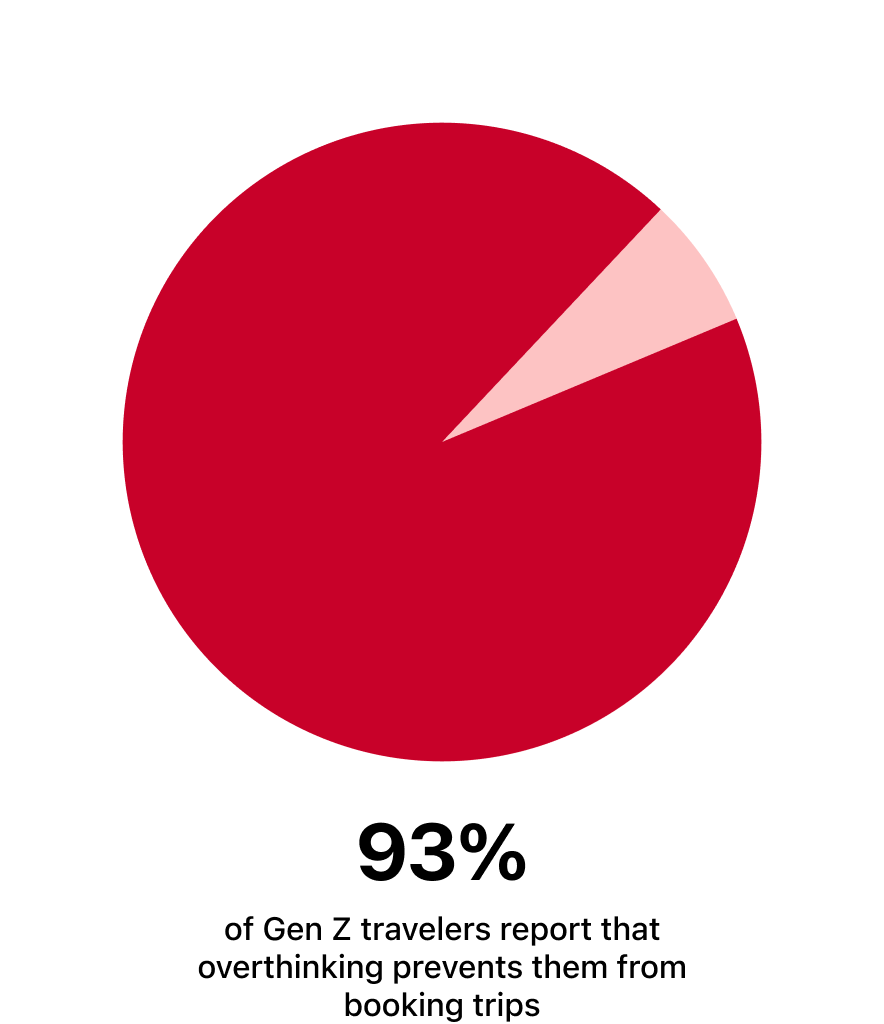
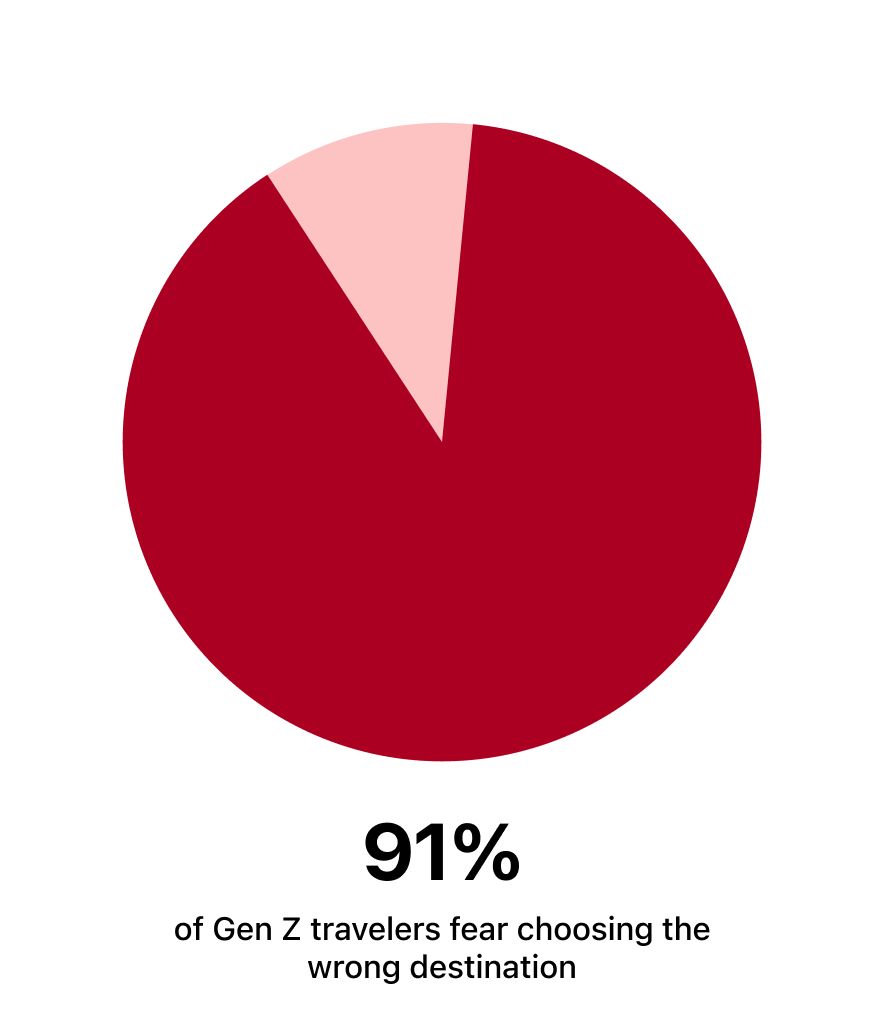
This research suggested that the challenge isn't discovering places to go—it's transforming saved inspiration into clear, confident travel plans.
Problem #2: FRAGMENTATION
Even after users decide where they'd like to travel, the planning experience becomes increasingly fragmented.
Travelers frequently jump between Pinterest boards, TikTok videos, Google Maps, Notes, spreadsheets, booking websites, and messaging apps just to organize a single vacation.
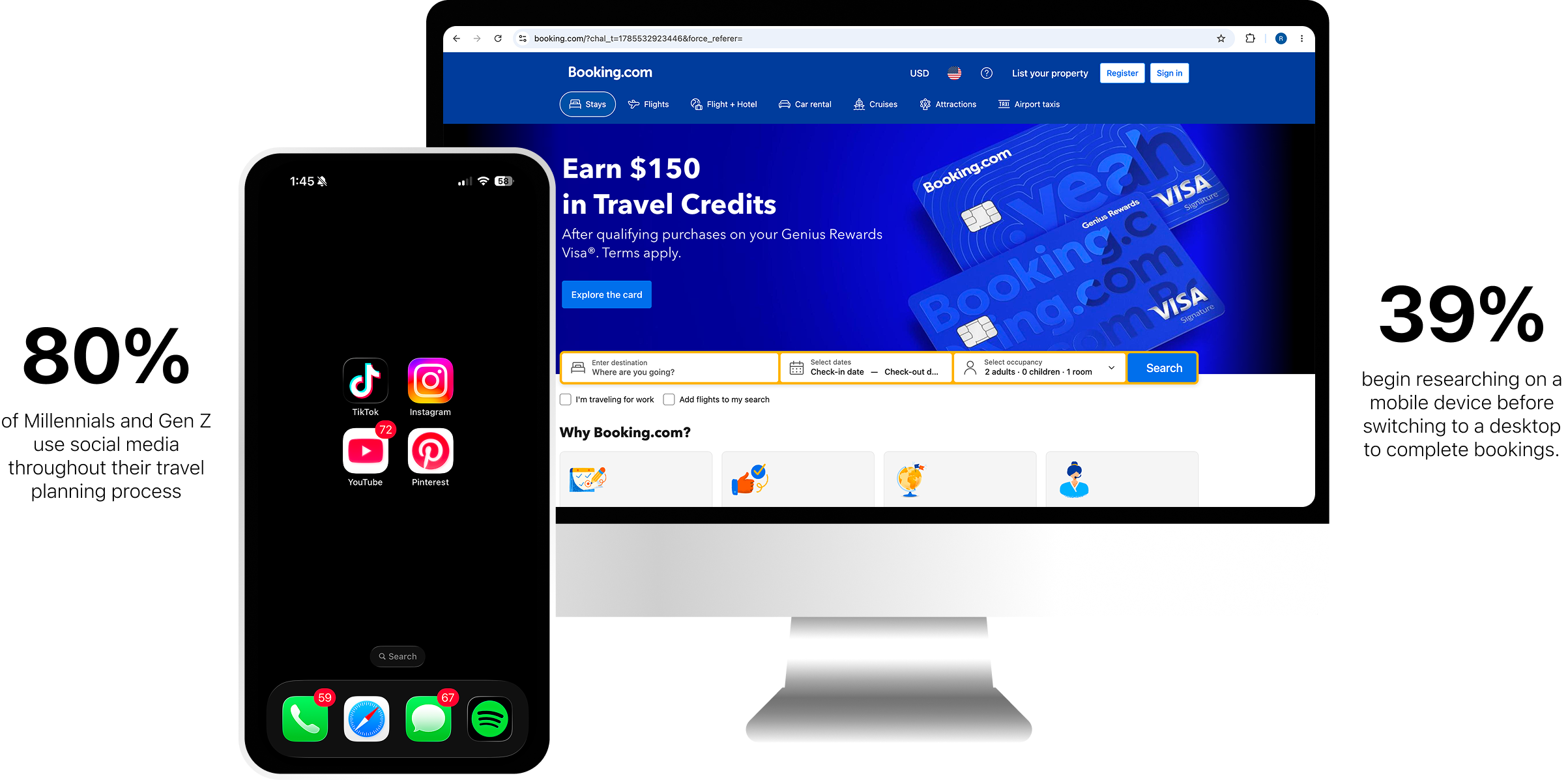
This constant context switching creates unnecessary friction and forces users to manually piece together information across multiple platforms.
These findings revealed an opportunity to bridge the gap between inspiration and execution by allowing users to transform saved Pins into an organized, interactive travel planning experience.
Solution & SUccess
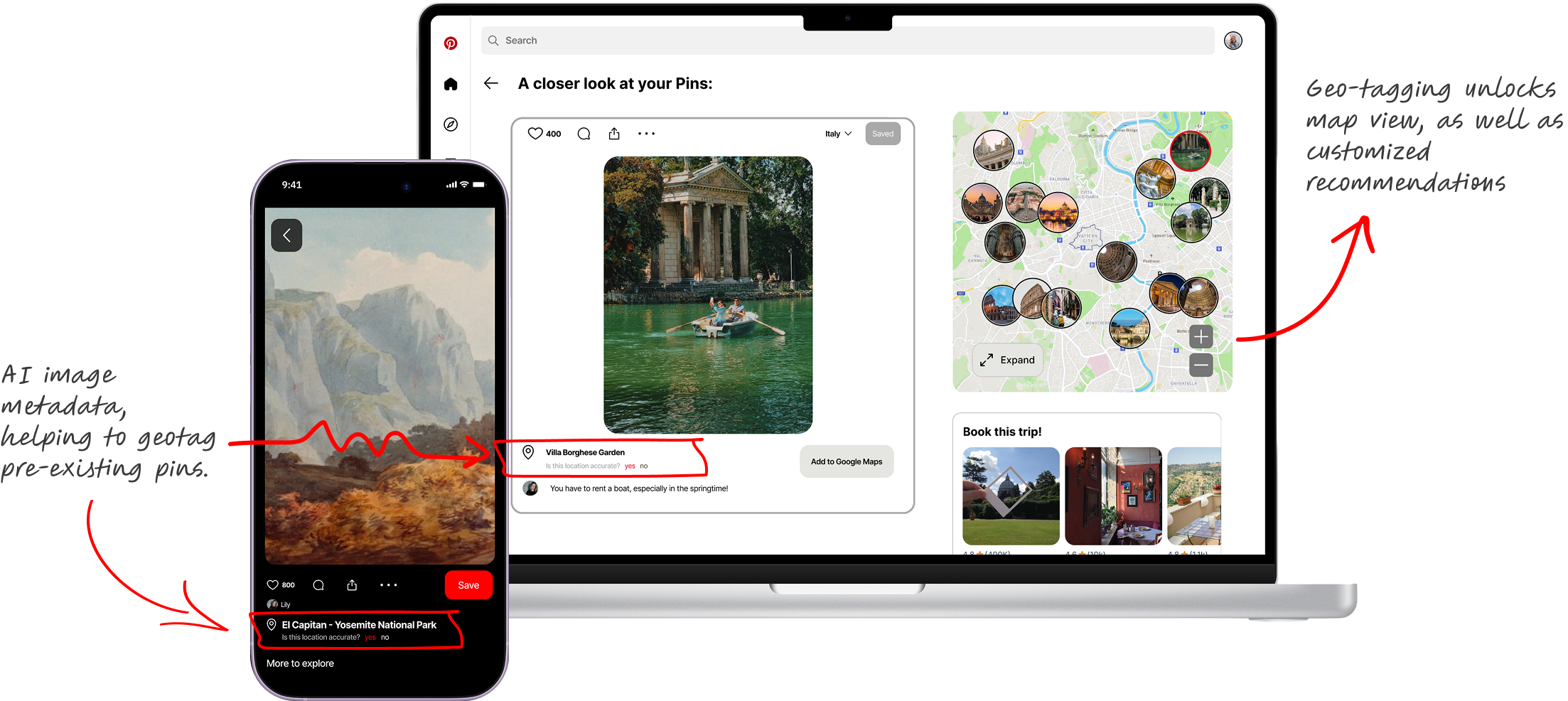
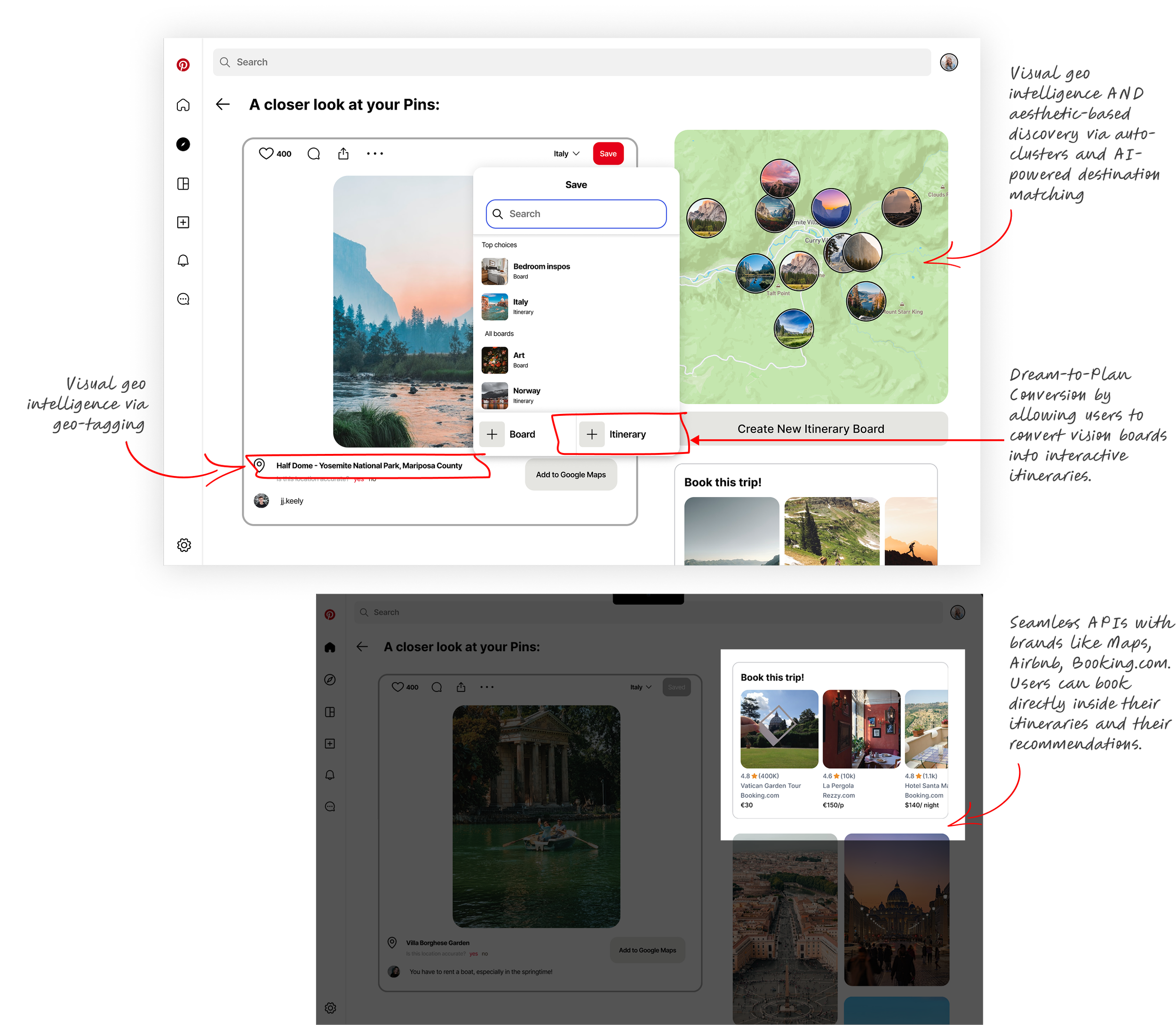
The solution is to introduce geo-tagging across Pinterest’s ecosystem, enabling travel inspiration to seamlessly translate into actionable plans. When creators upload Pins, they can add a location tag indicating where the photo was taken. For pre-existing Pins, AI will extract location data from image metadata.
These tags power smart recommendations, unlock a Map View in Discover for exploring destinations visually, and support itinerary-building by letting Pinners build their own AI-powered itineraries or remix others’ itinerary boards. Together, these features transform Pinterest from a source of inspiration into a tool for planning real-world adventures, creating seamless Dream-to-Plan conversion.
Competitive Landscape
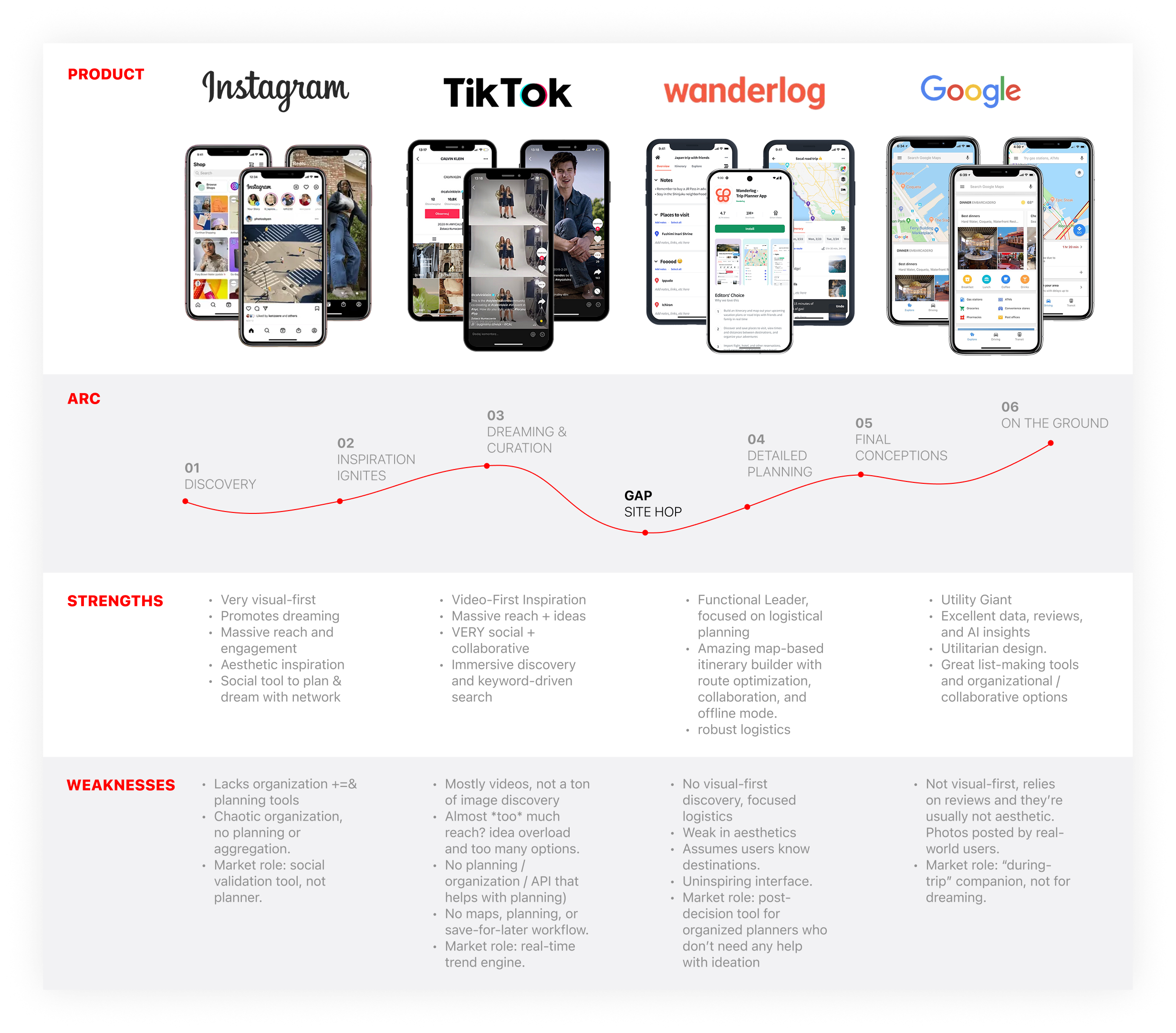
After evaluating both visual-first competitors and products in the itinerary and travel-planning space, a clear opportunity emerged: Pinterest is uniquely positioned to unite the full travel-planning journey. Today, users experience a disconnect between the excitement of discovering inspiration and the more logistical process of turning that inspiration into an actionable trip. By closing this gap, Pinterest has the opportunity to carry users seamlessly from “I want to go there” to “I’m going there.”
Whitespace Opportunities
The whitespace lies between aspirational content (Instagram/TikTok) and functional planning (Wanderlog/Google Maps).
Pinterest can own the inspiration-to-itinerary continuum. The user’s emotional arc is disrupted between inspiration and actualizing the their dream trip in real life. Pinterest has an obvious opportunity to unite all steps of a user’s planning journey.
Differentiation levers
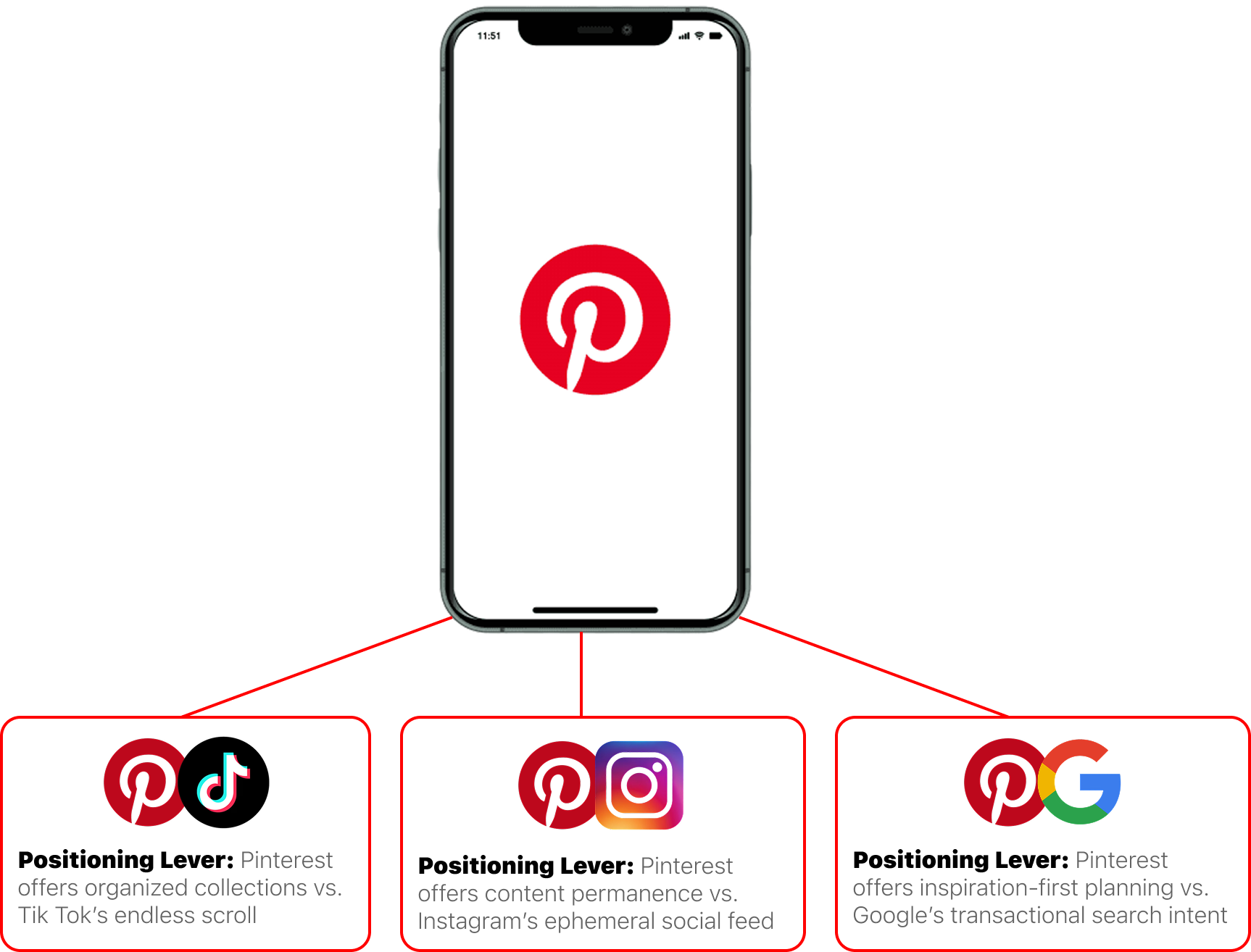
Based on these findings, my initial hypothesis was that establishing Pinterest’s strategic positioning as “the only platform where your travel dreams become trip plans” would require four key differentiation levers:
Visual geo-intelligence: Pins auto-geo tag and then auto cluster by location
Aesthetic-based discovery: AI suggests destinations matching users’ visual taste (“Find places that look like this”).
Dream-to-plan conversion: Convert vision boards into interactive itineraries.
Seamless partnerships: Integrate with Maps, Airbnb, Booking.com rather than compete.
Why could this work? Pinterest users already use the platform to curate travel, aesthetic, and lifestyle inspiration, yet no existing platform fully connects visual style, geographic discovery, and itinerary creation within a single experience. Together, these differentiation levers could allow Pinterest to move users from dreaming → organizing → executing, while building on—rather than diluting—its existing creative DNA.
WHo’s Our target audience?
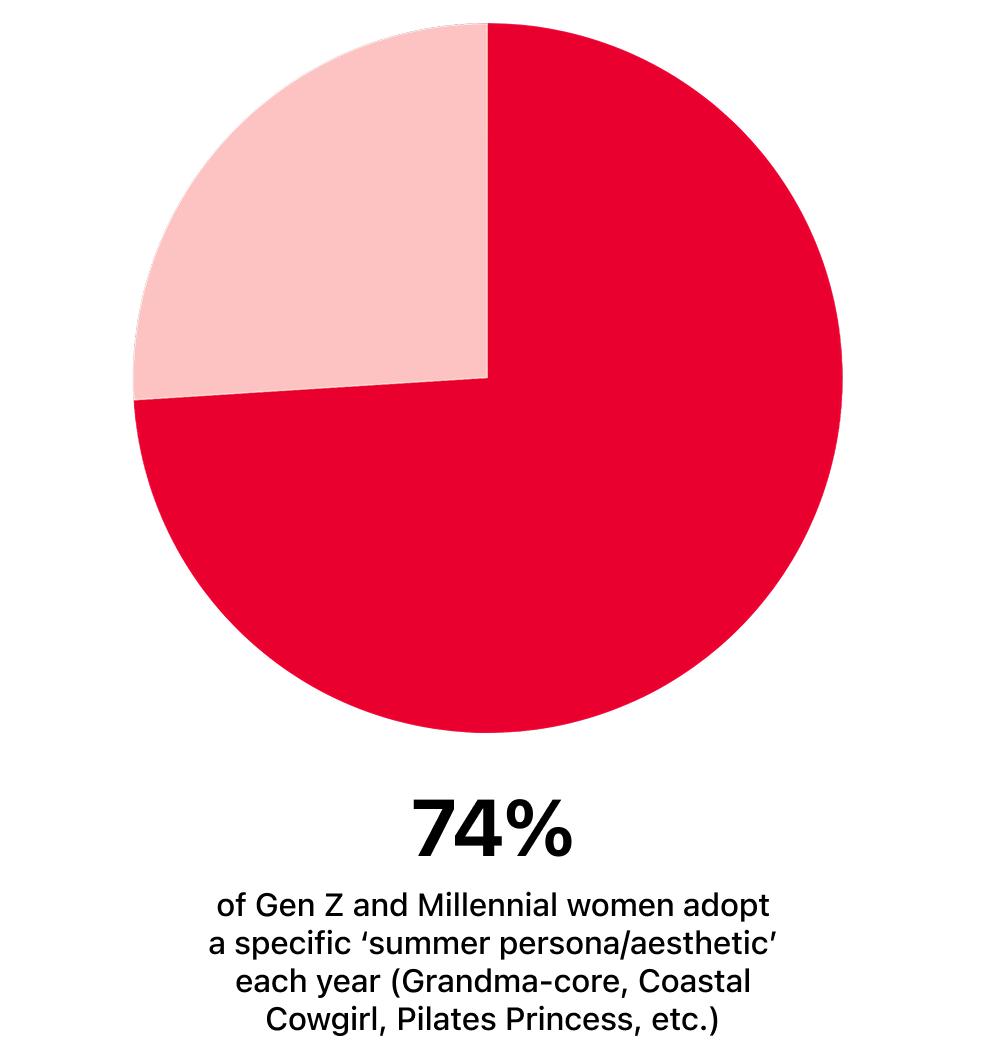
Talker research studied 2,000 Millenials and Genz and learned that 74% of these women used apps like Pinterest to discover a summer persona, and they actively aligned vacations, outfits and food choices based on that persona.
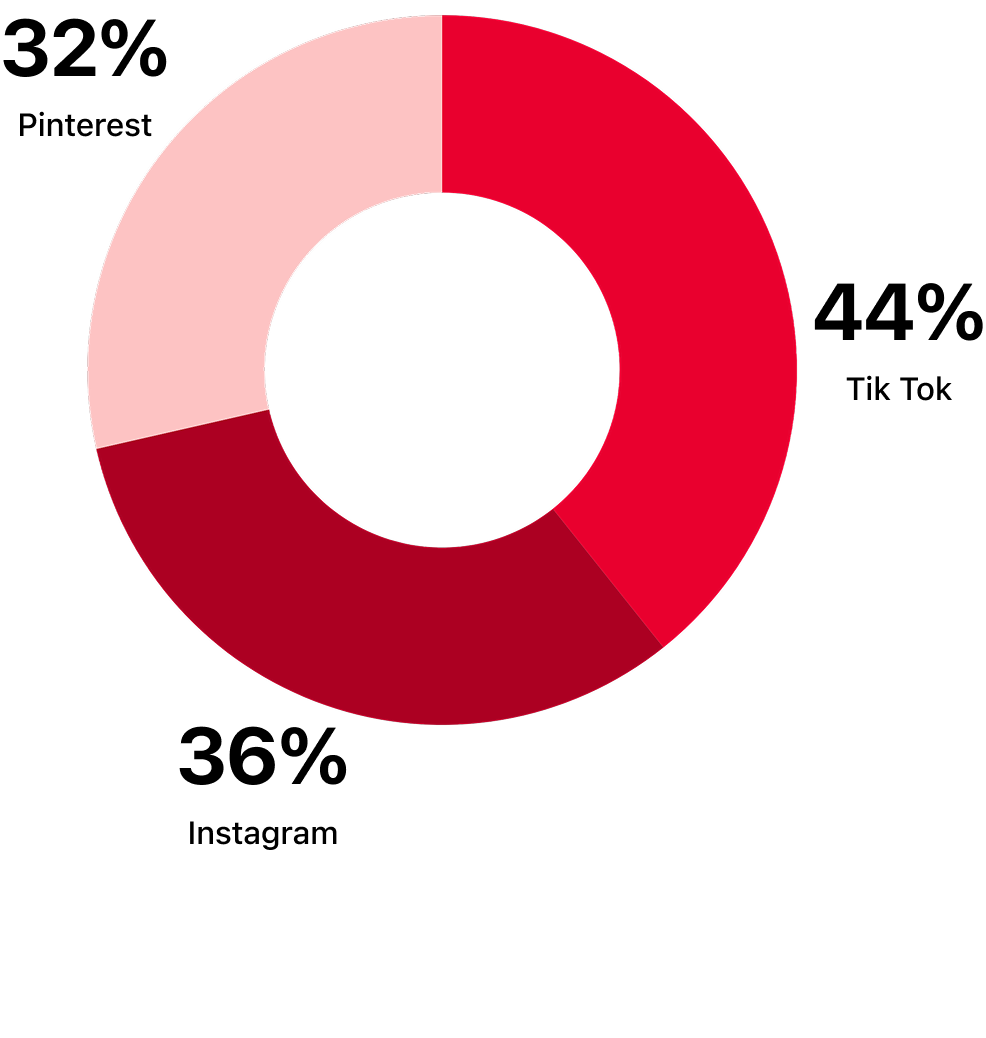
Based on this research, a clear target audience emerged: creative female travelers between the ages of 25–34 who value beauty and are often inspired to plan and book trips based on aesthetics. With discretionary spending power, this audience typically falls within the $75K–$105K income range.
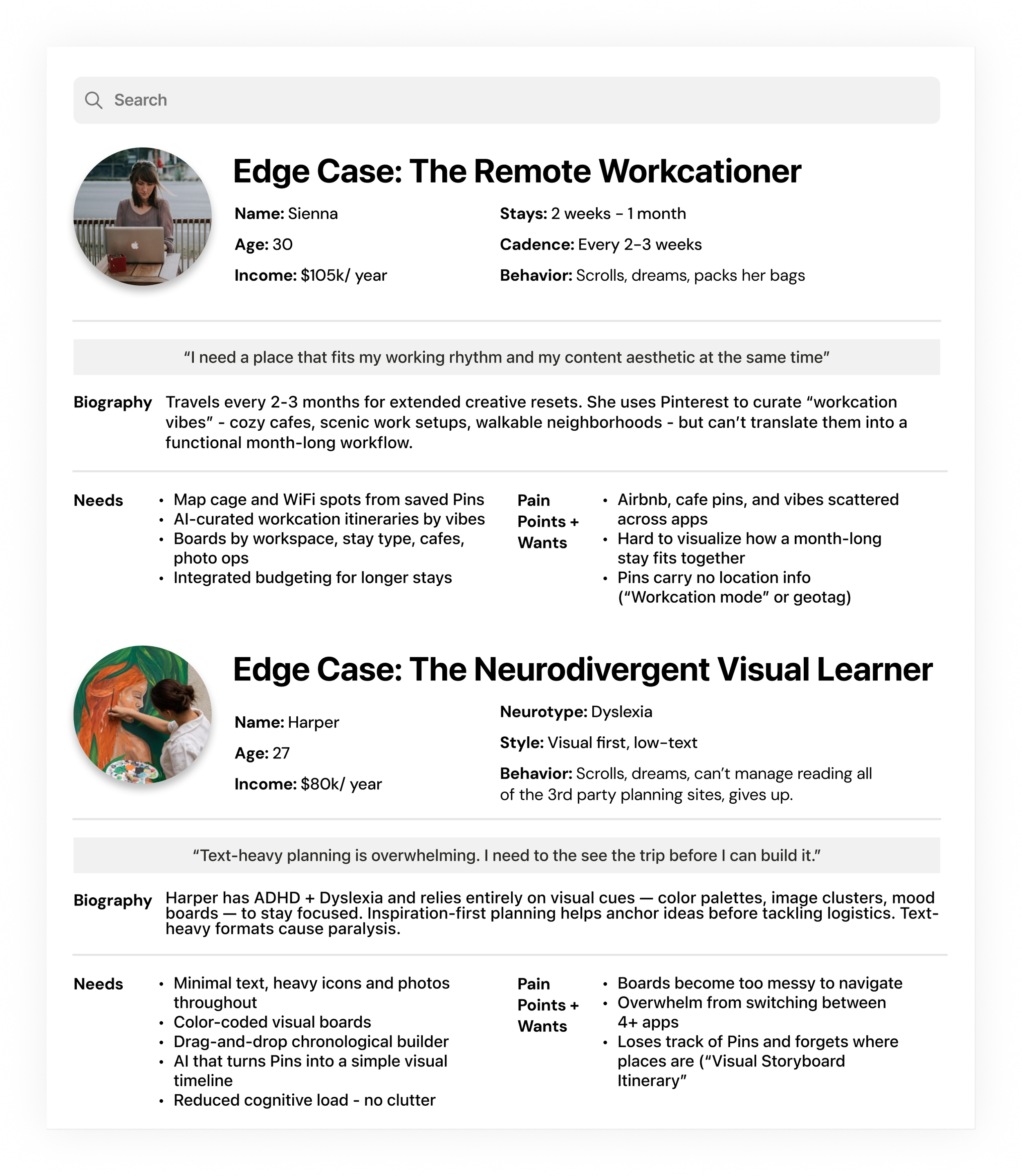
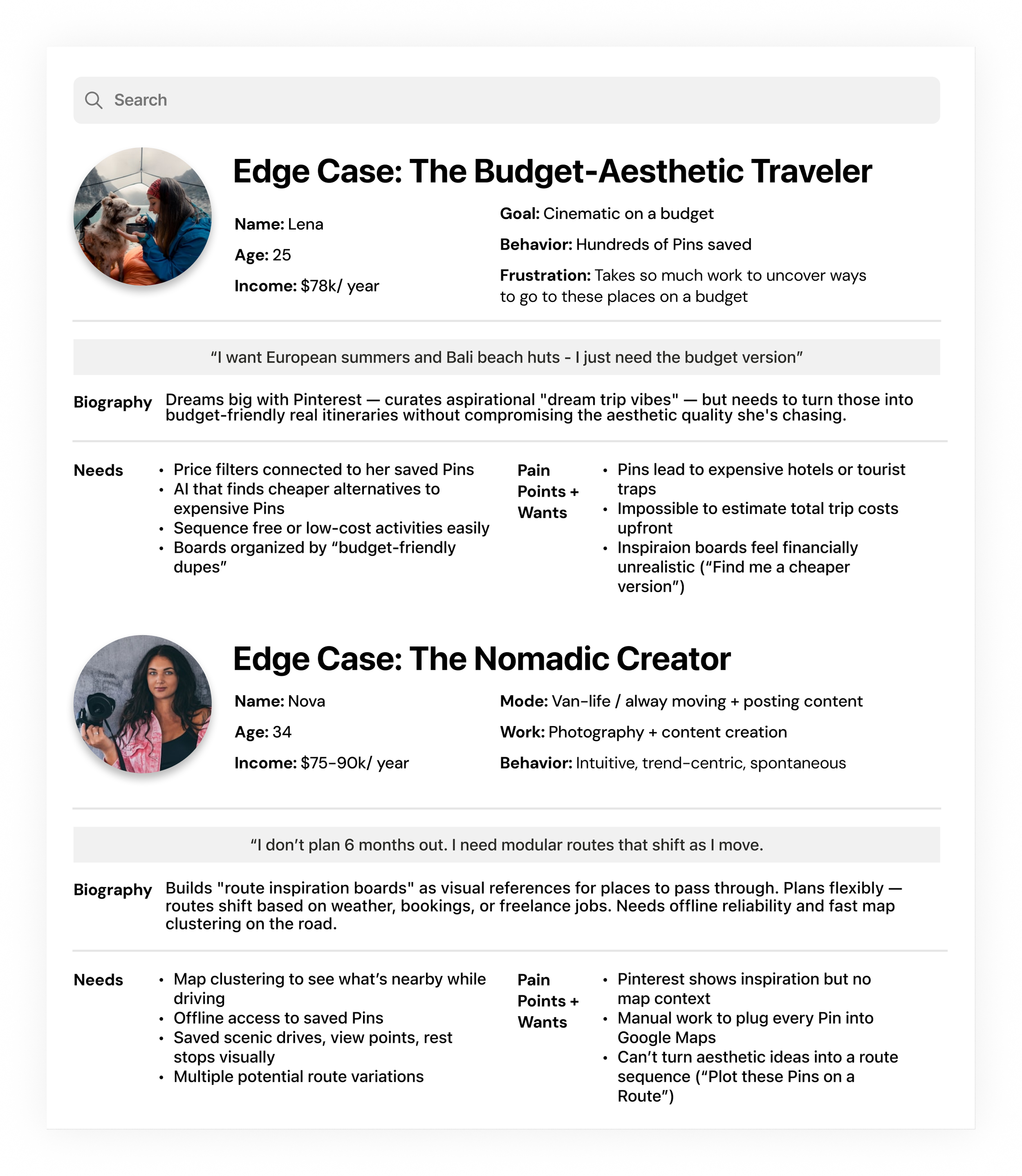
While defining the core audience is essential, considering edge cases helps account for the different circumstances in which users may rely on visual inspiration to begin the planning process. A digital nomad, workcationer, budget-conscious traveler, or neurodivergent user, for example, may each approach travel planning differently while still benefiting from an experience rooted in visual discovery.
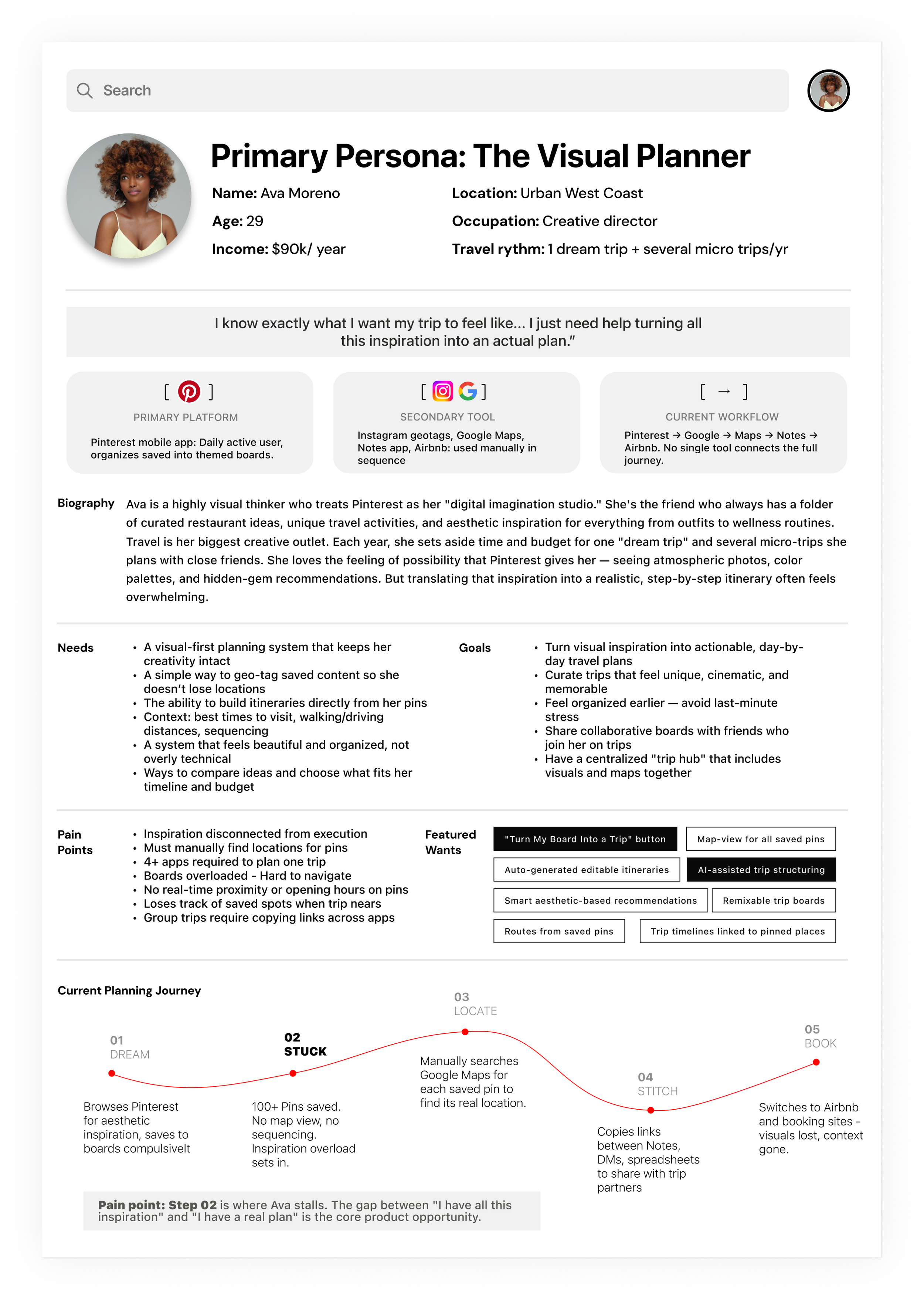
Meet the user segments that will help inform my design process: Ava, Siena, Harper, Nova, and Lena.
SURVEY RESULTS
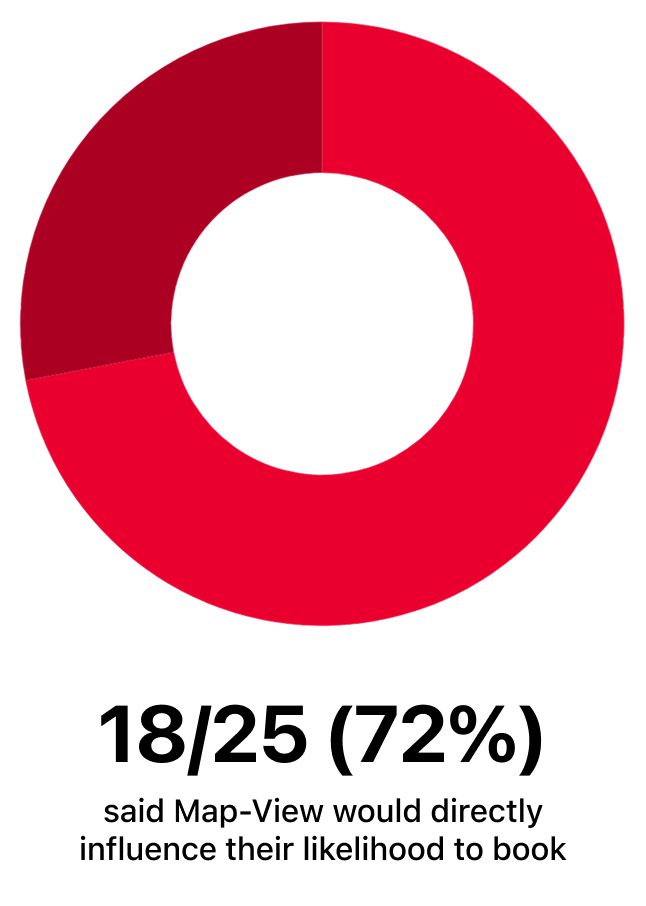
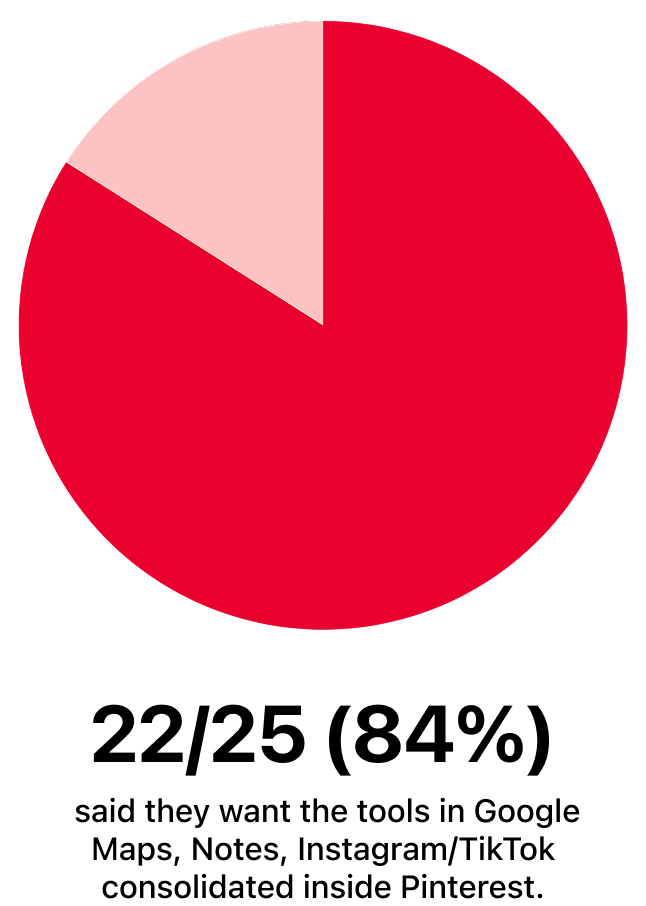
To begin validating my assumptions, I conducted a simulated survey informed by reputable secondary research on Gen Z and Millennial travel behaviors, particularly around visual inspiration and aesthetics. The survey explored users’ travel planning behaviors, pain points, and the features they would need to consider Pinterest as an end-to-end travel planning tool.
These initial findings helped shape my interview questions and provided a foundation for further investigation into the opportunities and challenges surrounding the travel planning experience.
SYNTHESIS + Journey Mapping
I synthesized the survey findings and simulated interview responses through thematic clustering to identify recurring behaviors, pain points, and unmet needs. The patterns consistently revealed a disconnect between Pinterest’s strength as an inspiration tool and its ability to help users act on that inspiration. While early ideas such as geo-tagging, AI-powered suggestions, and visual-first itineraries emerged as promising solutions, I used journey maps, empathy maps, and task flows to pressure-test these opportunities and ensure I wasn’t designing around assumptions.
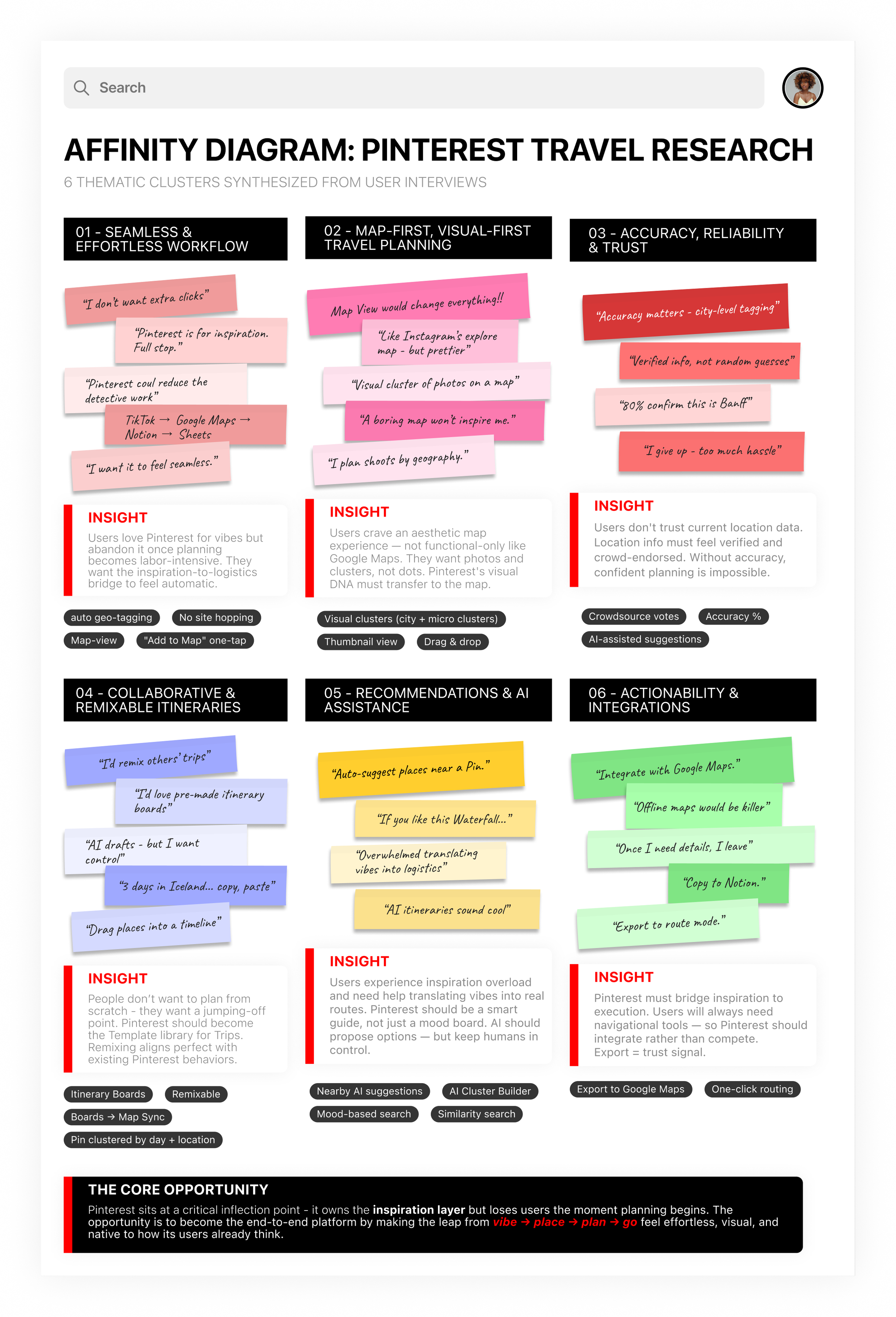
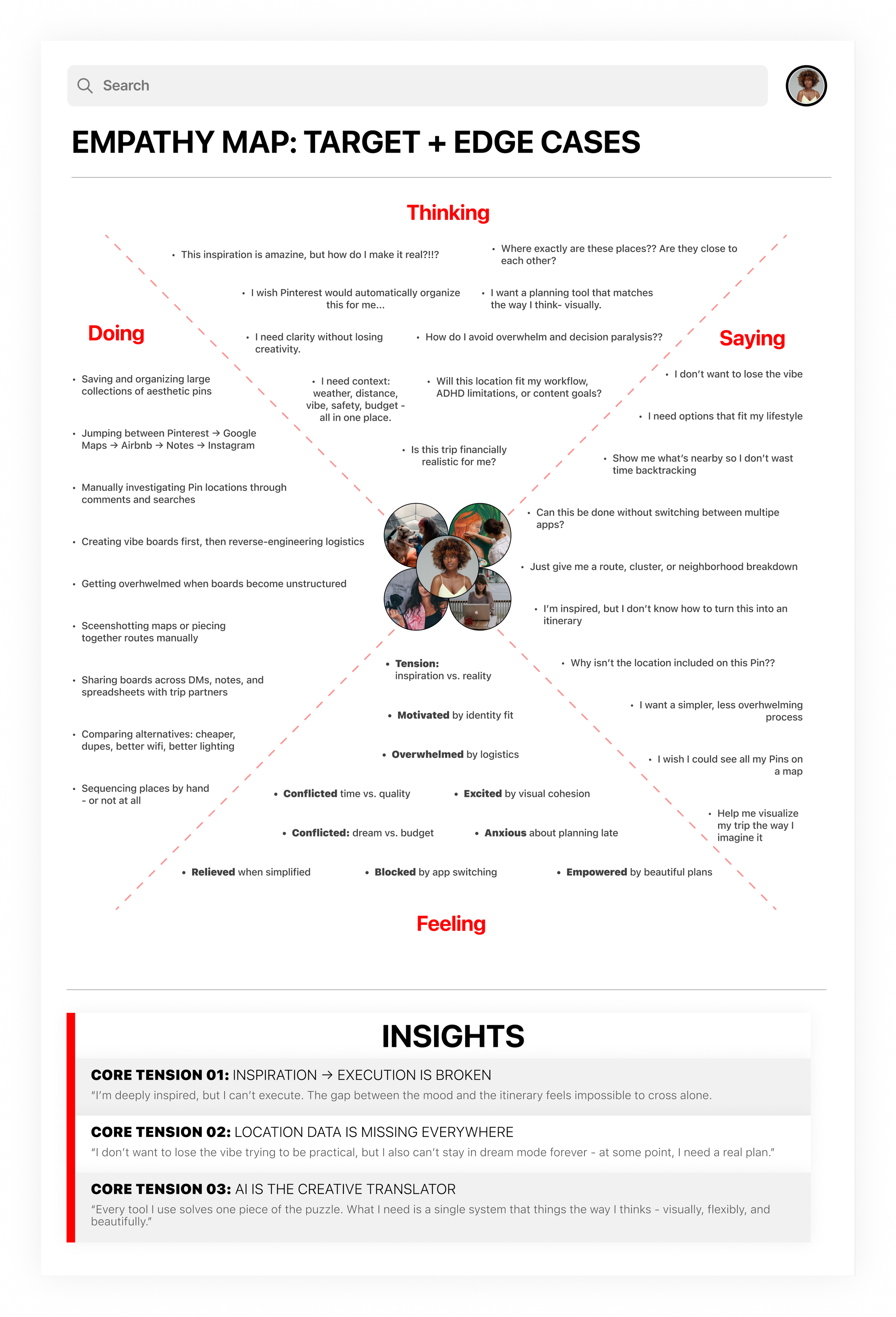
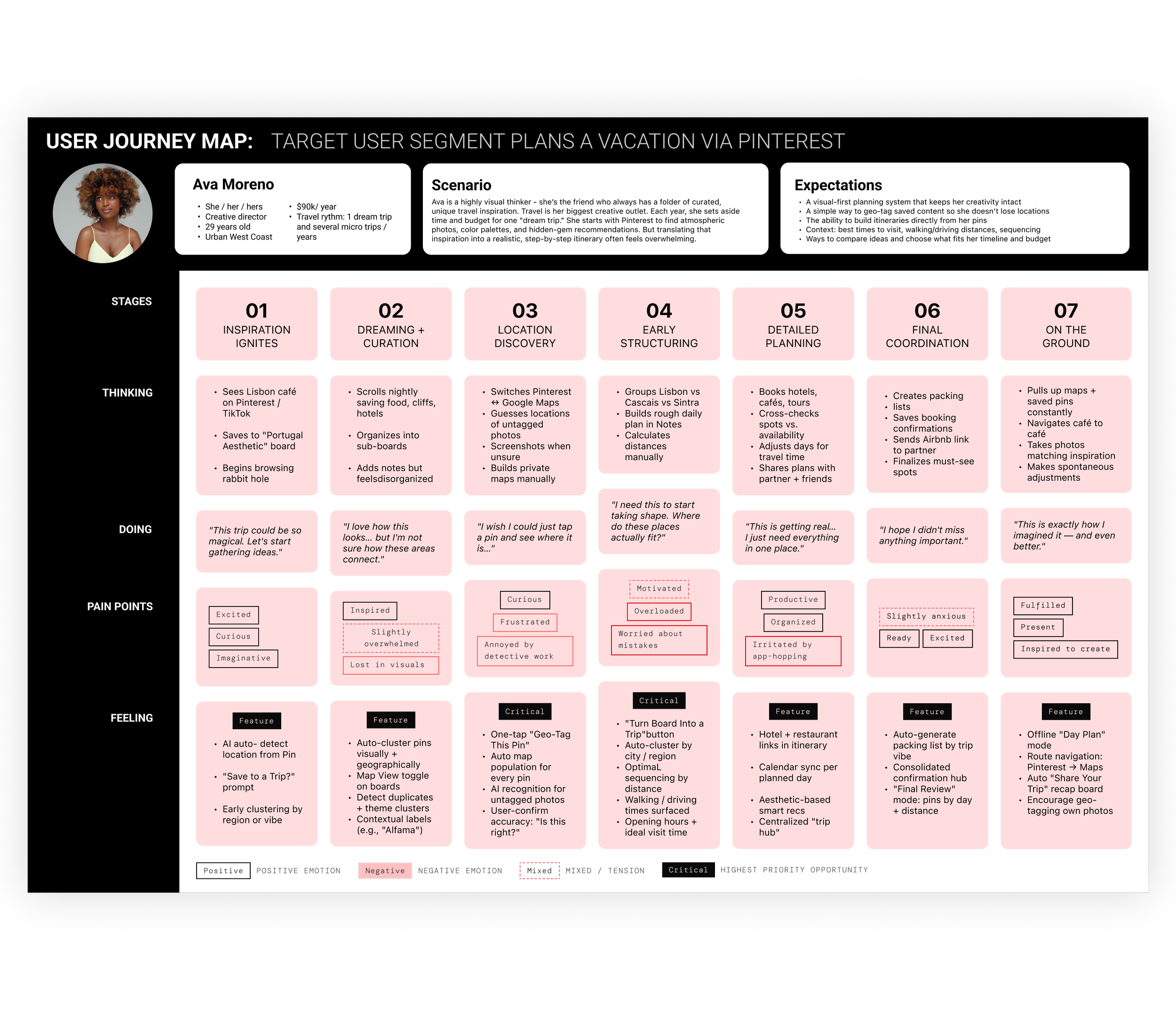
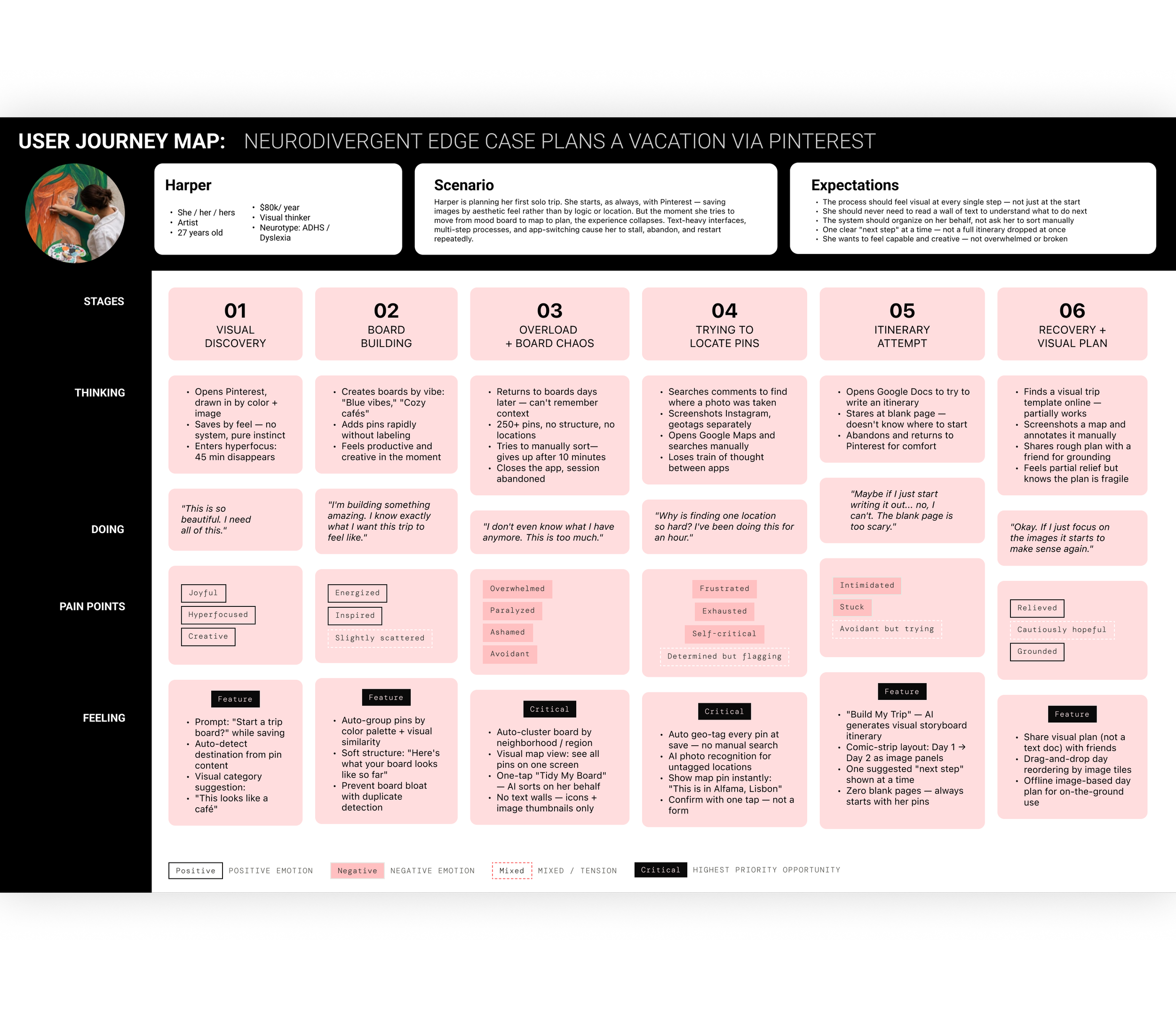
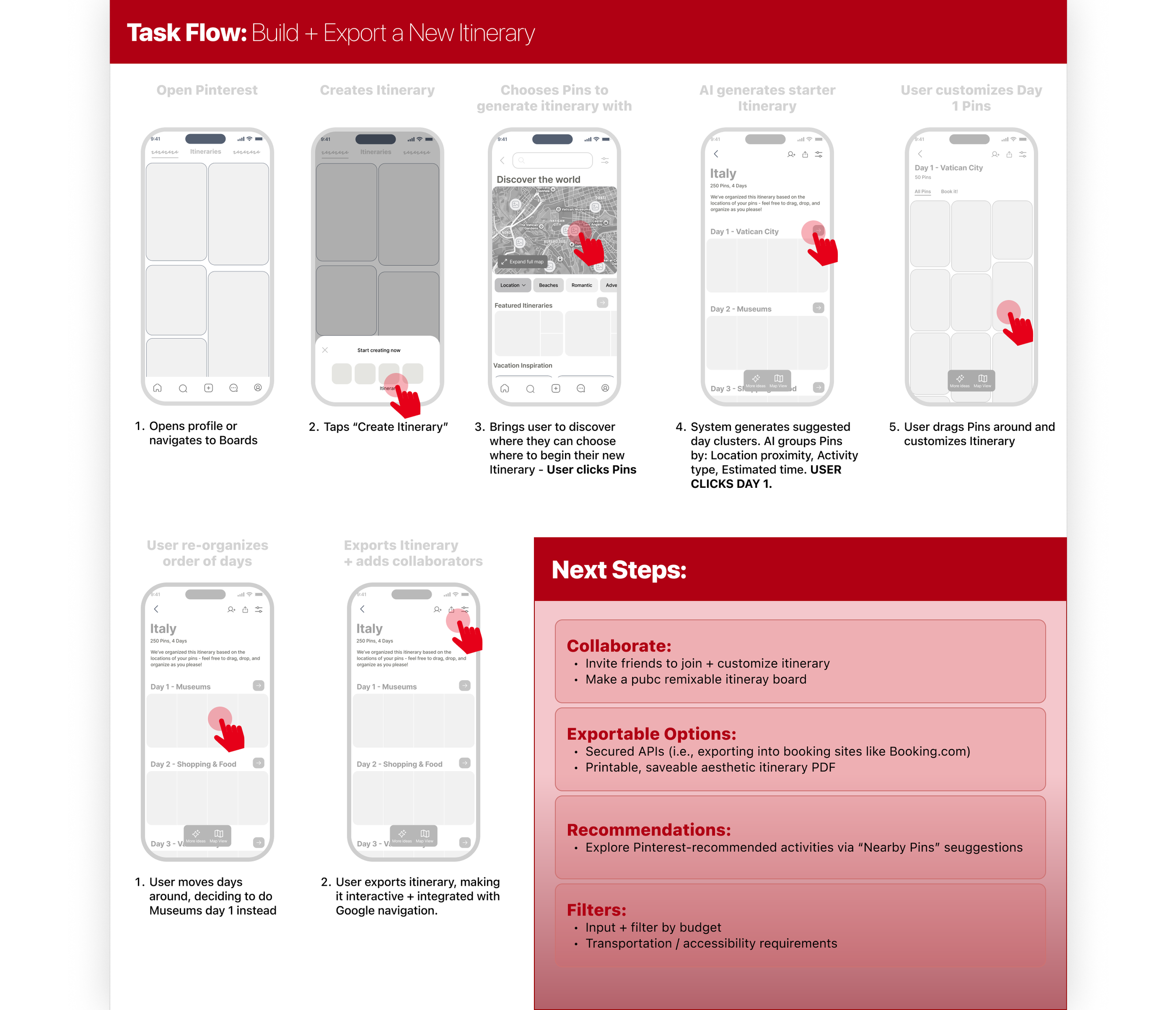
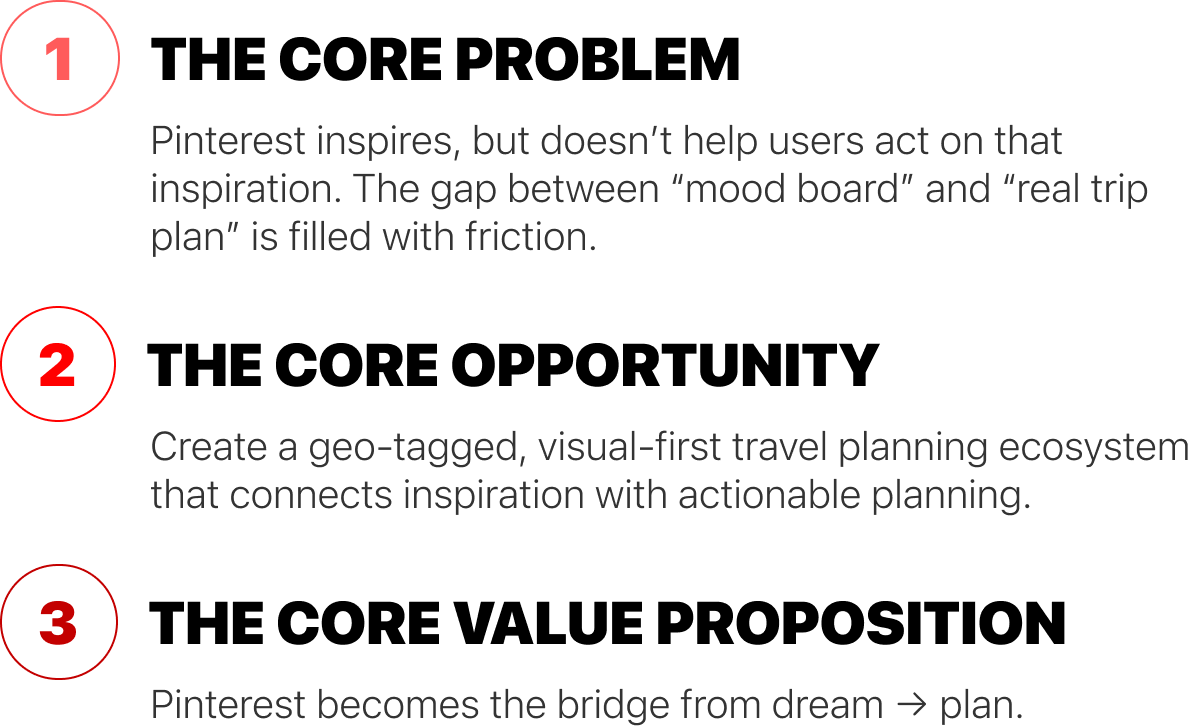
The synthesis ultimately surfaced three key findings: the core problem, the core opportunity, and the resulting value proposition.
Synthesis + mapping led me to focus the product direction on a geo-tagged, visual-first travel planning ecosystem—positioning Pinterest as the bridge from dream → plan, rather than simply another place to collect inspiration.
Wireframe sketches
I sketched early concepts within Pinterest’s existing UI and interaction patterns to keep the proposed experience familiar and low-friction. Because the geo-tagging initiative could require significant product development behind the scenes, I wanted the user-facing experience to feel intentionally simple—not like a major overhaul.
Rather than introducing entirely new workflows, I explored small, contextual additions that integrate naturally into Pinterest’s existing ecosystem: an additional option in dropdown menus, a new navigation destination, or a simple “Create” action. The goal was to make the new planning features feel like a natural evolution of Pinterest—not a separate product layered on top of it.
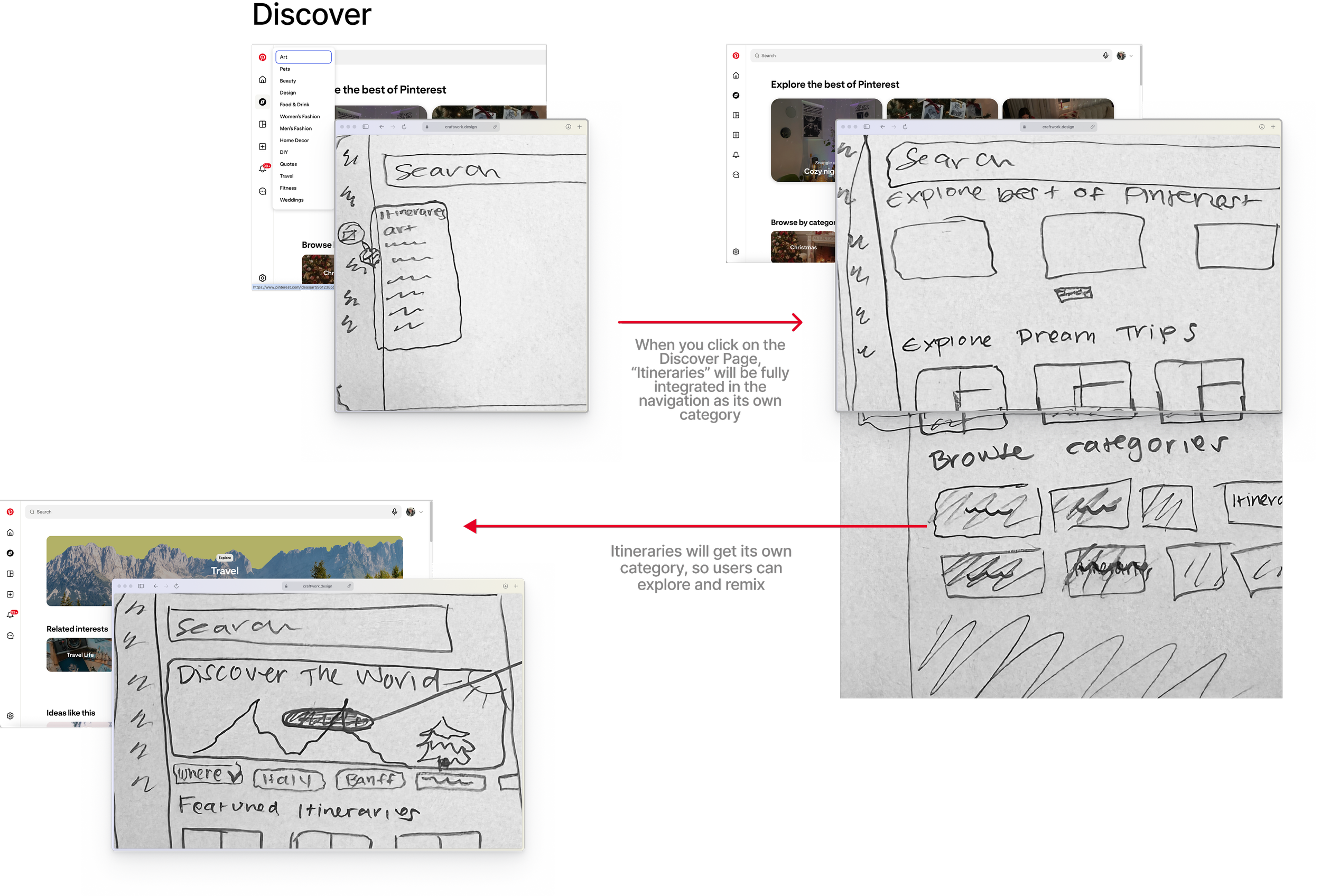
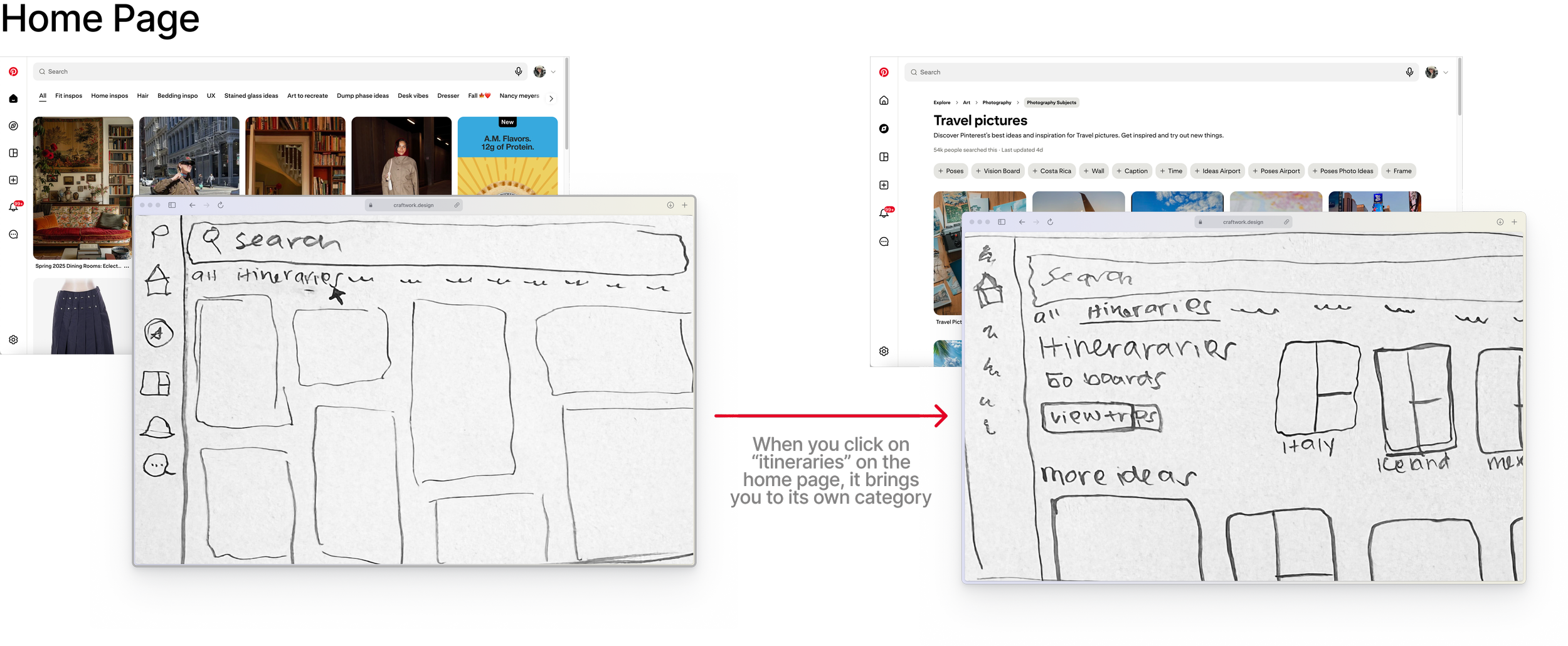
Wireframe Screens
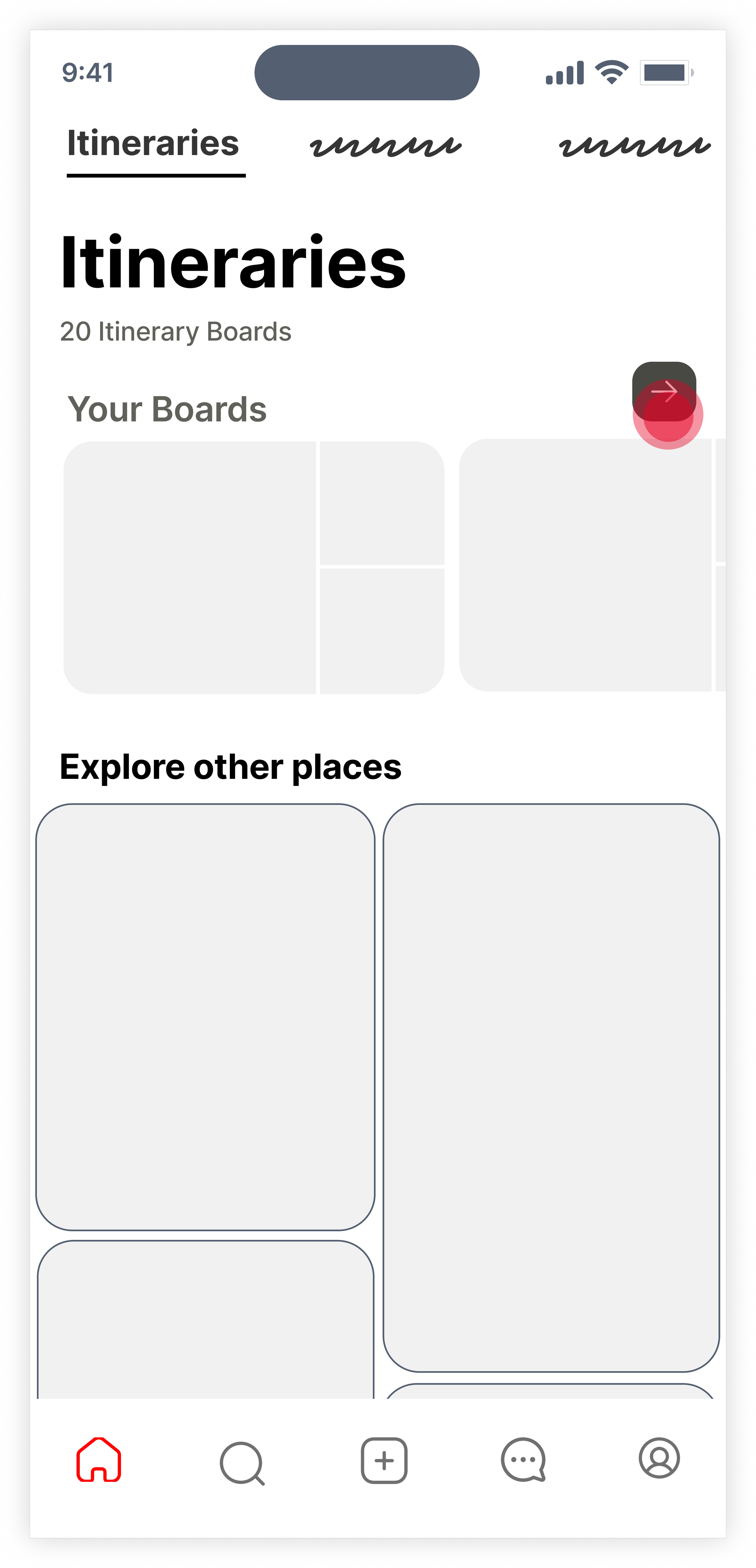
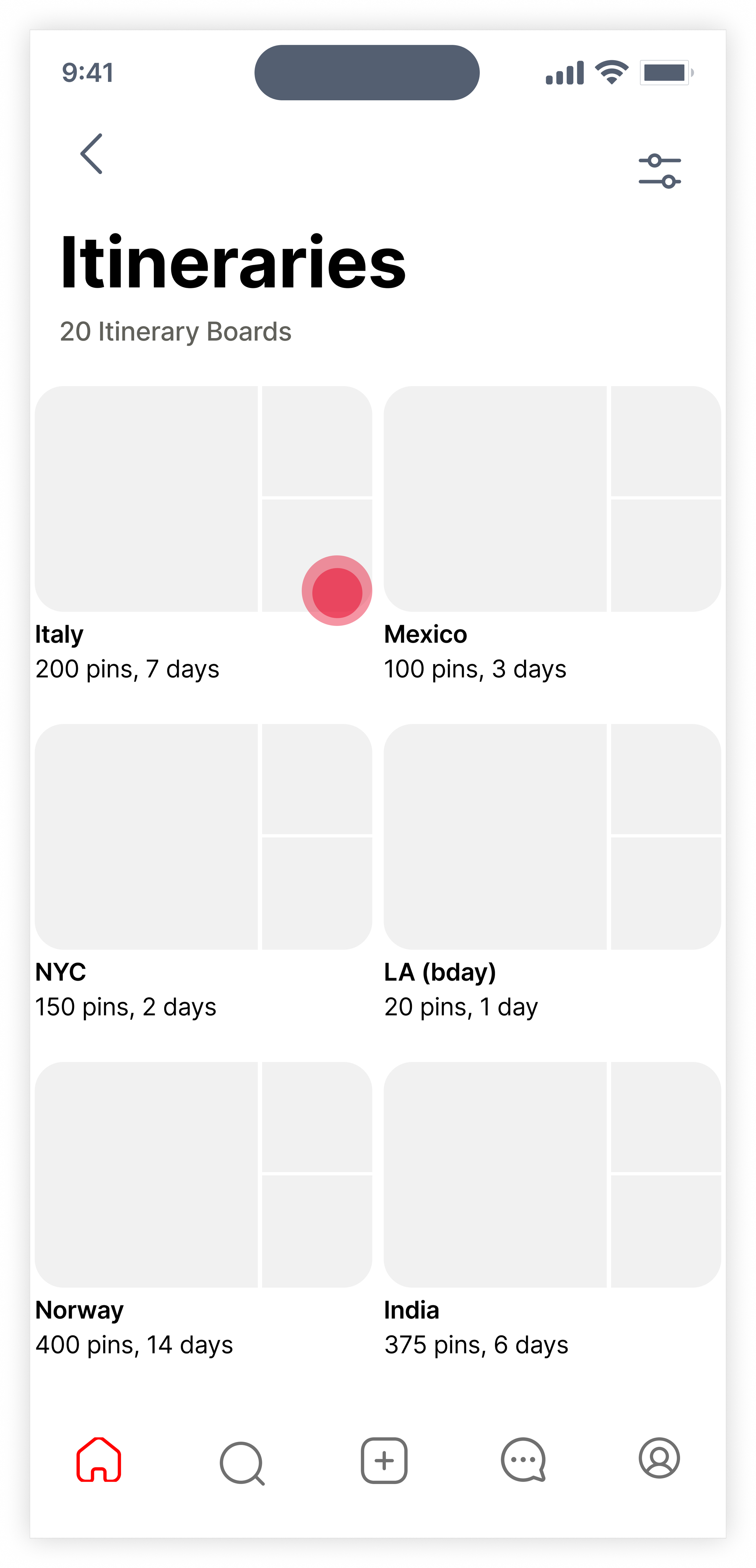
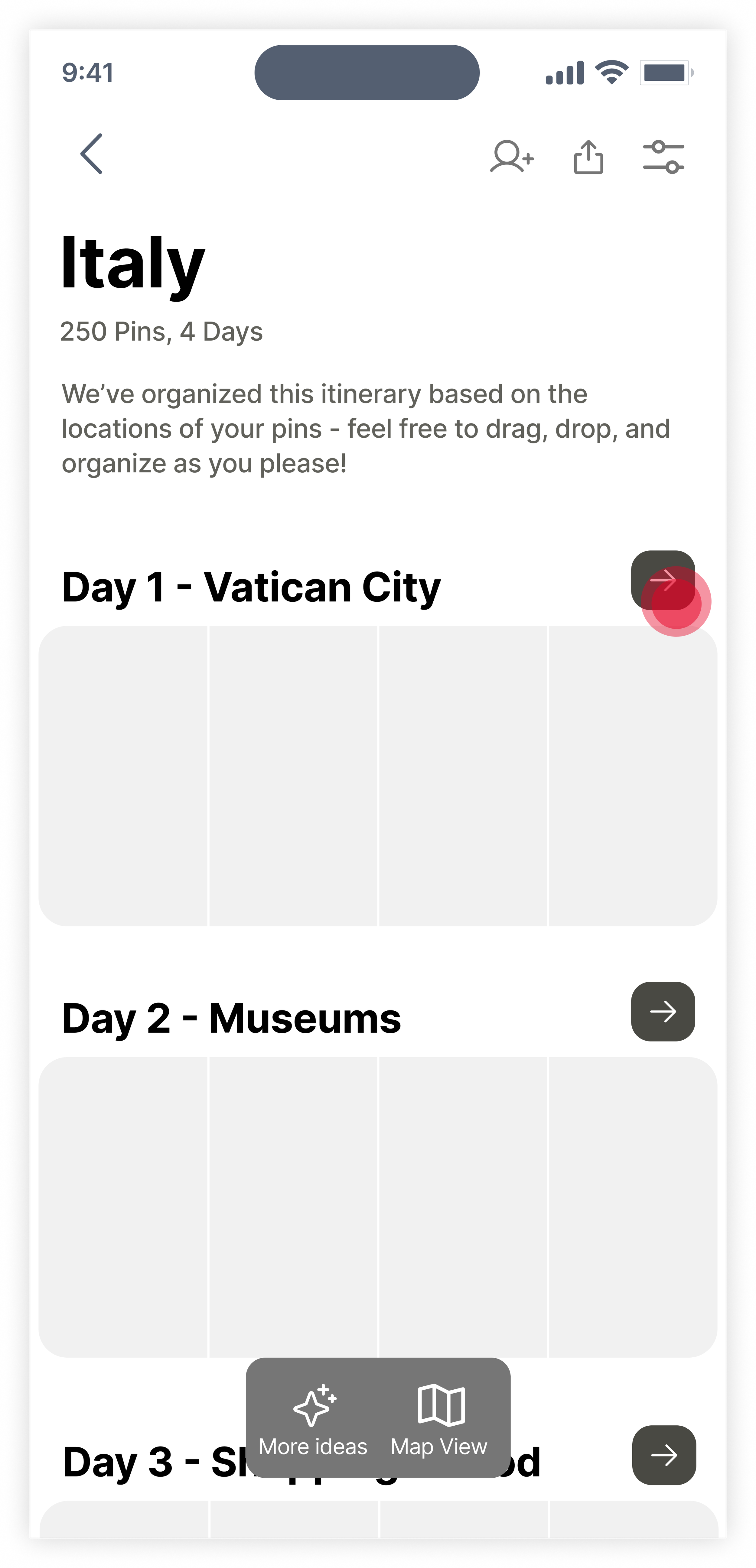
I wireframed key user flows to visualize how the proposed features would work in practice—from creating a personalized itinerary to discovering existing itineraries through map view. I also explored how booking options could be integrated into the experience, helping users move seamlessly from visual inspiration to actionable plans they could actually book and experience.
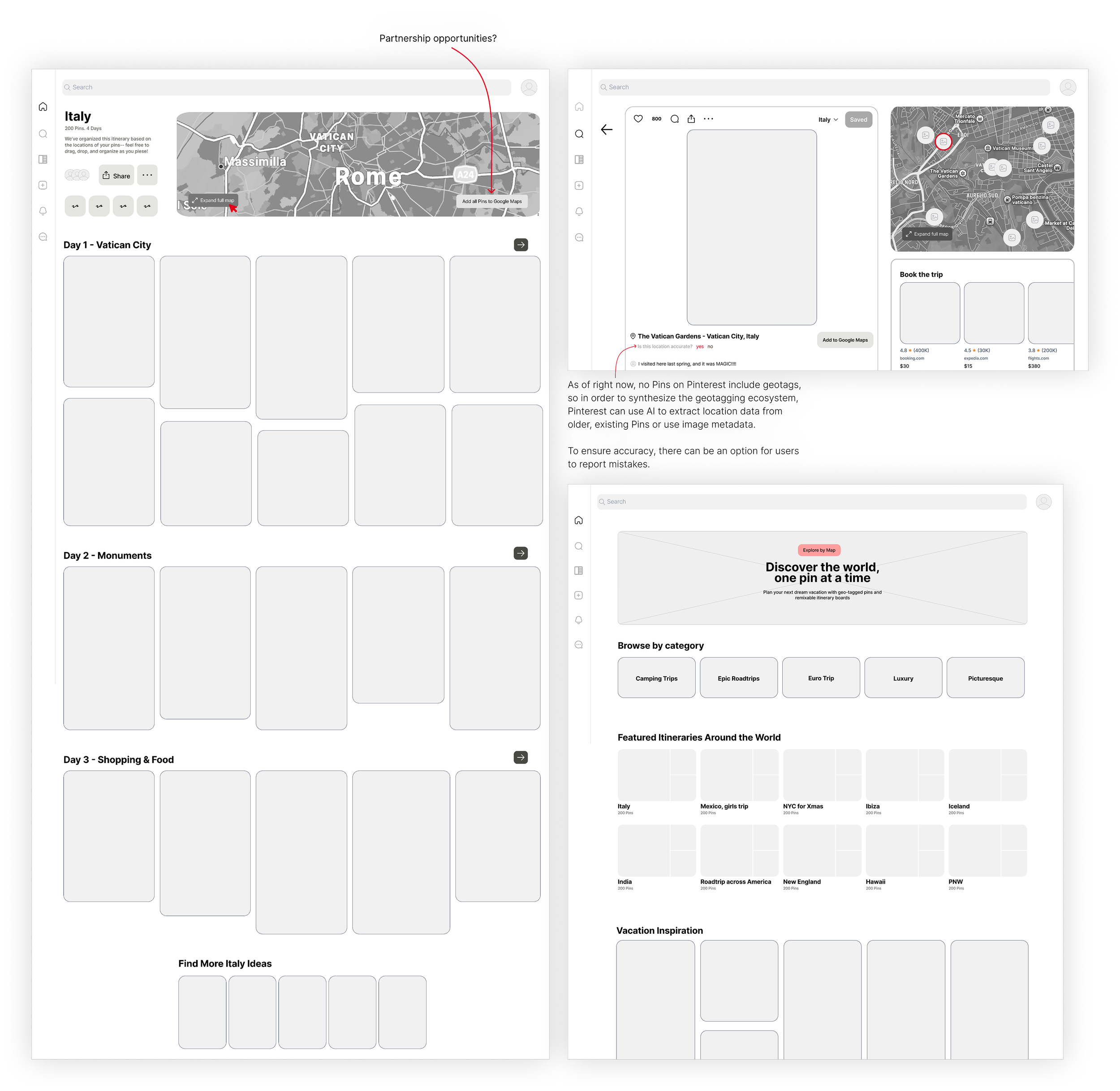
WEB:
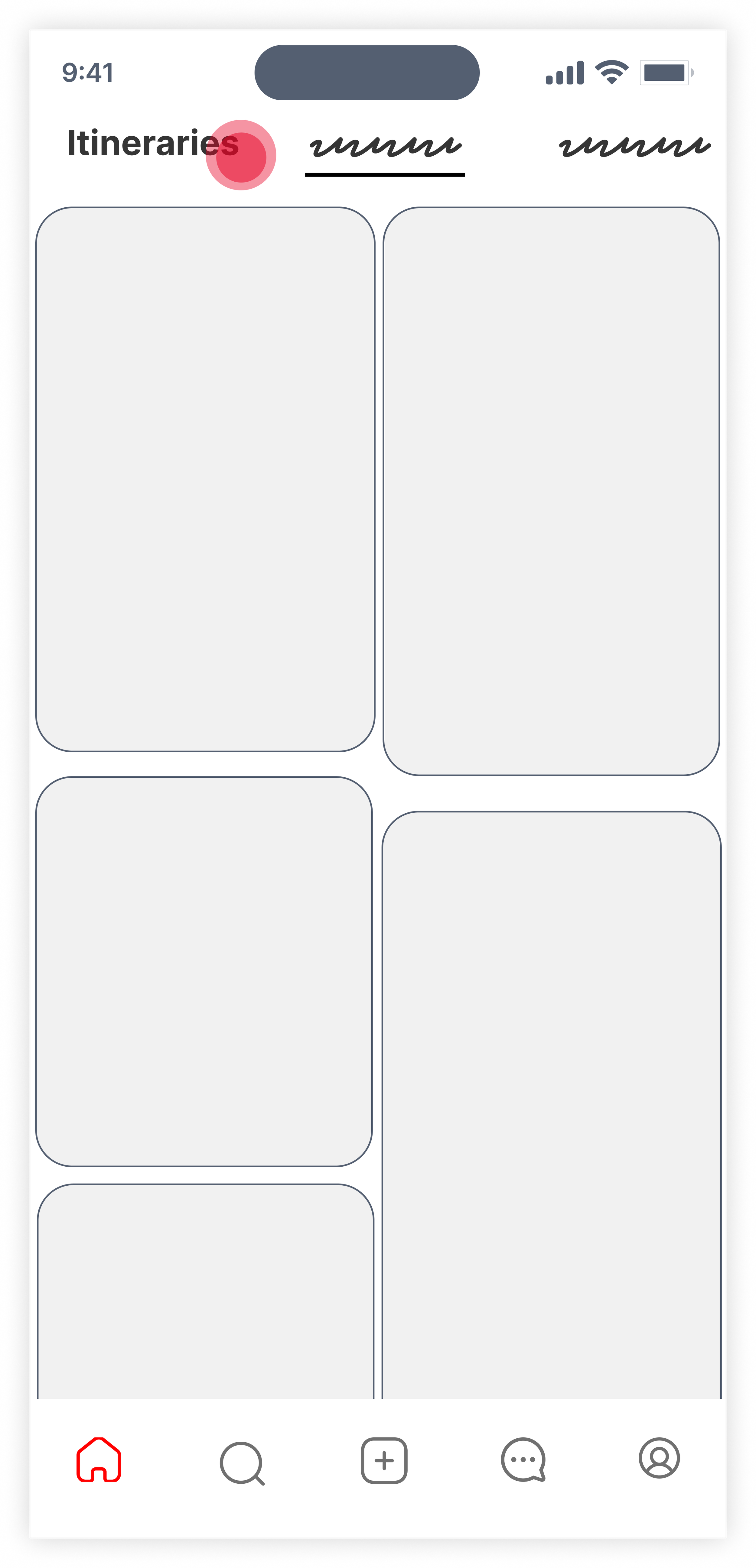
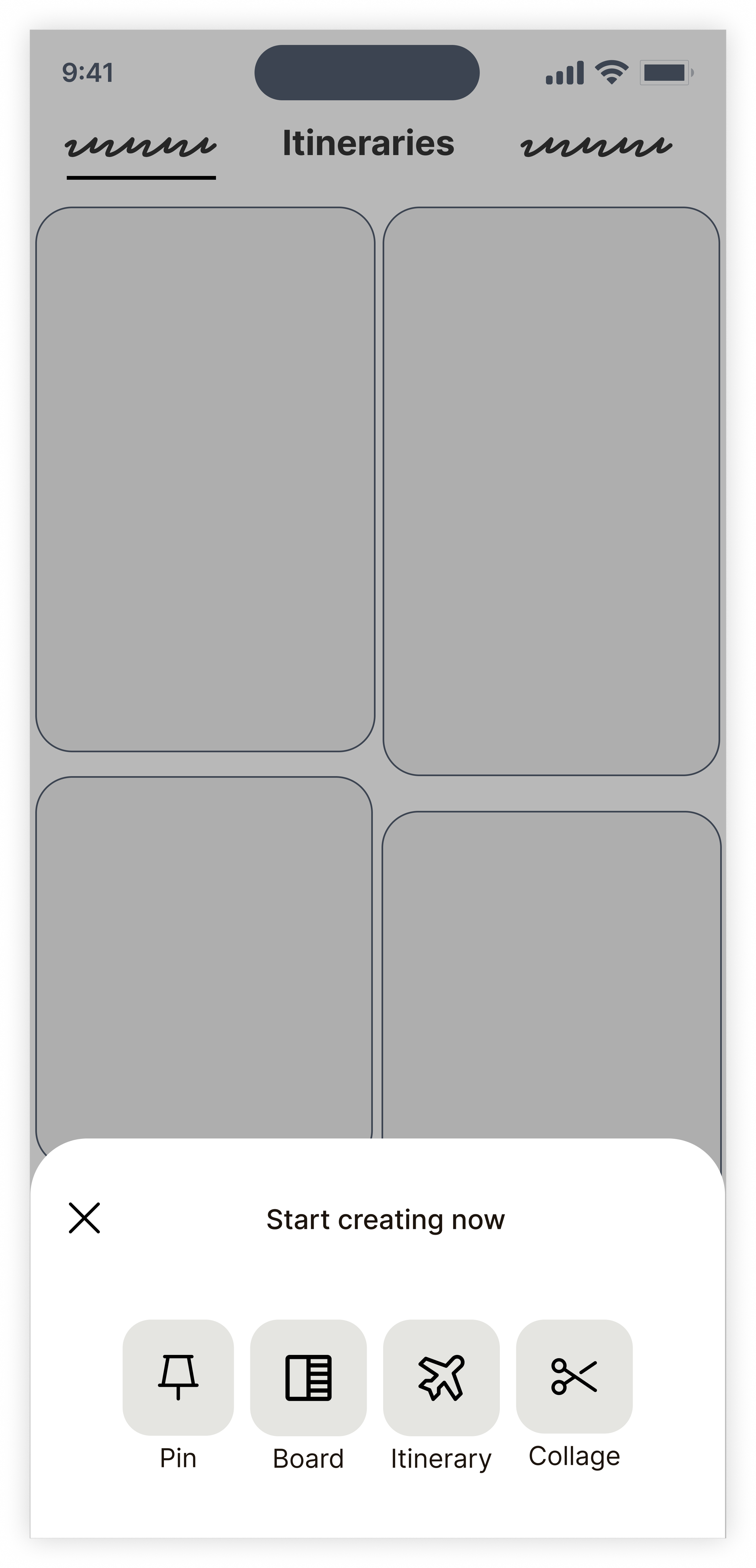
MOBILE:
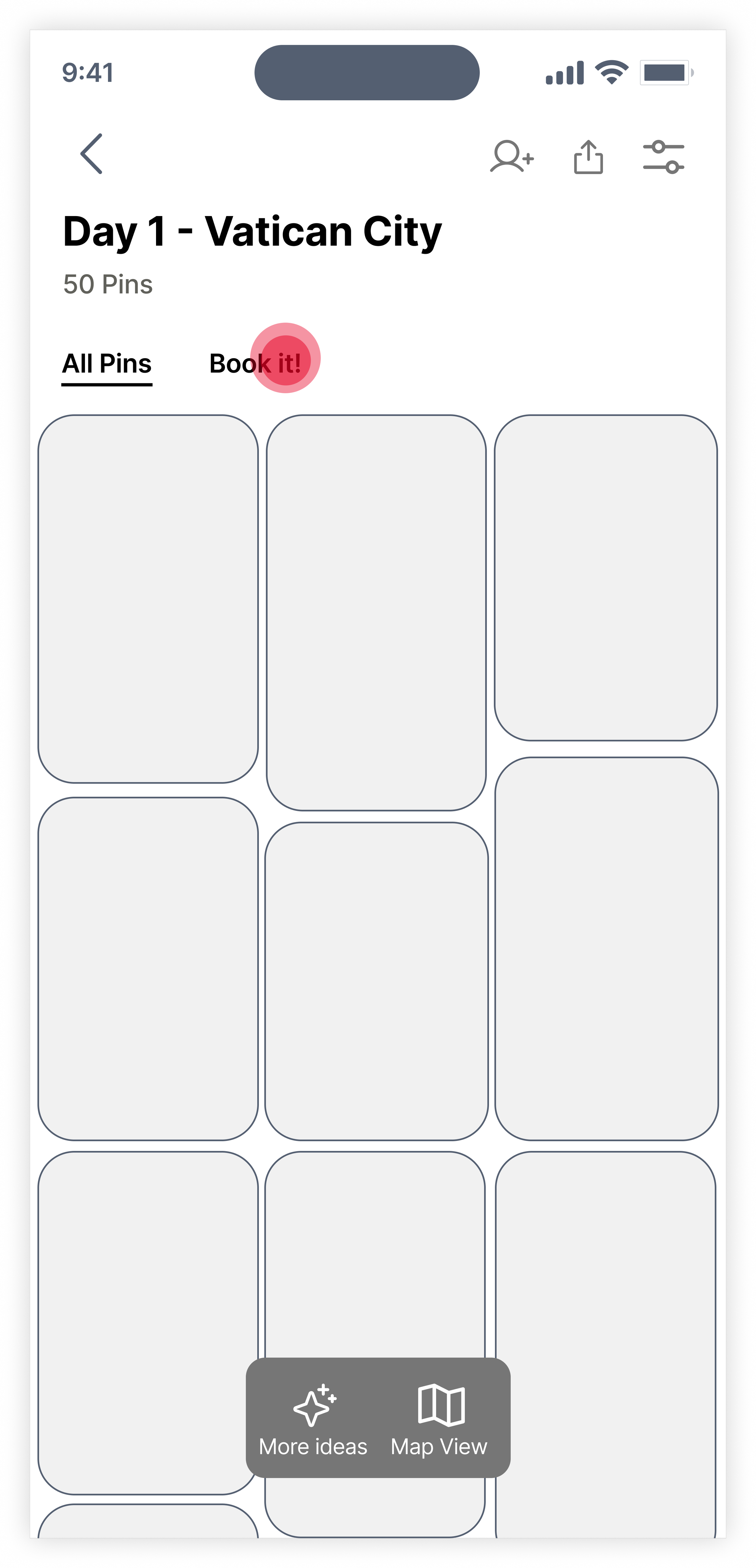
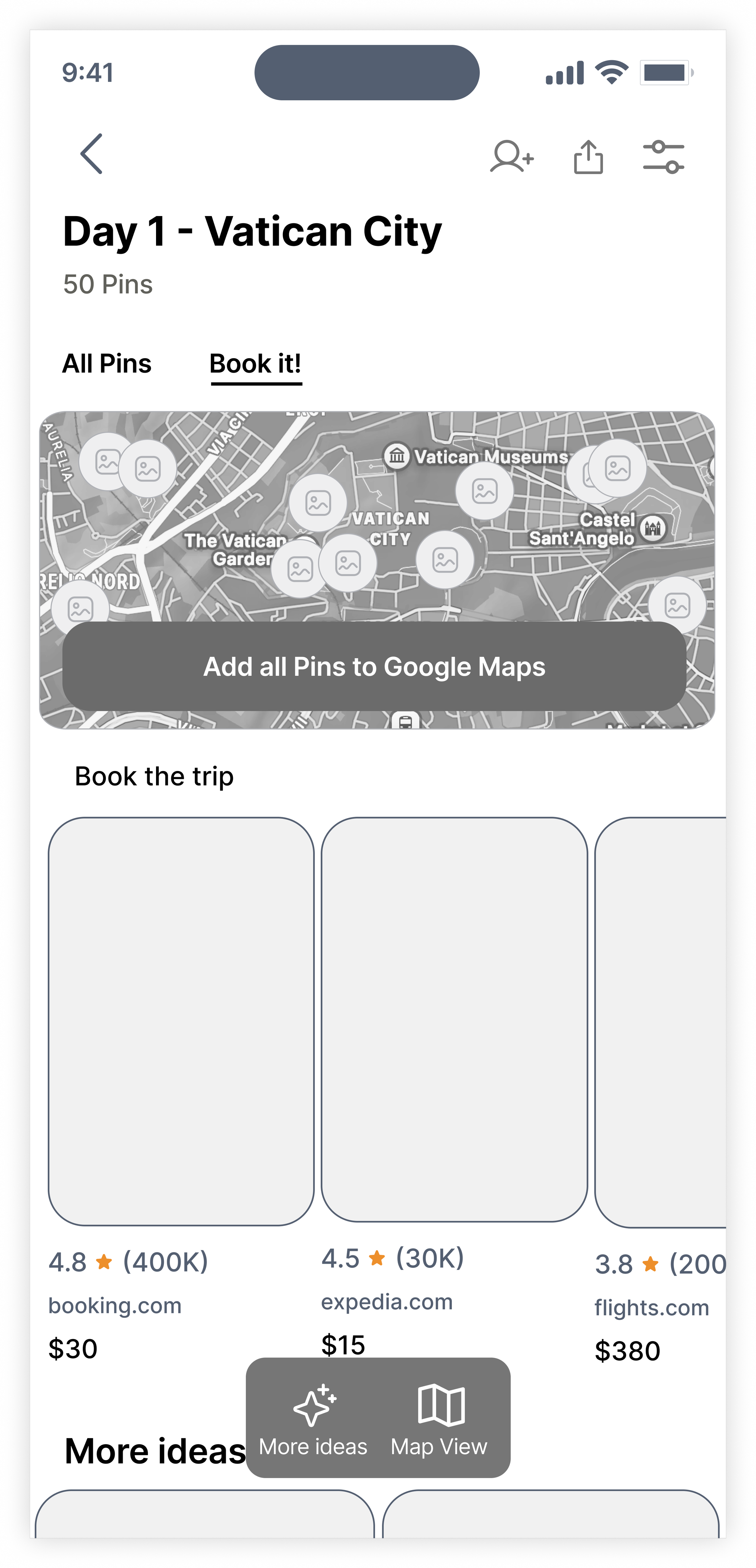
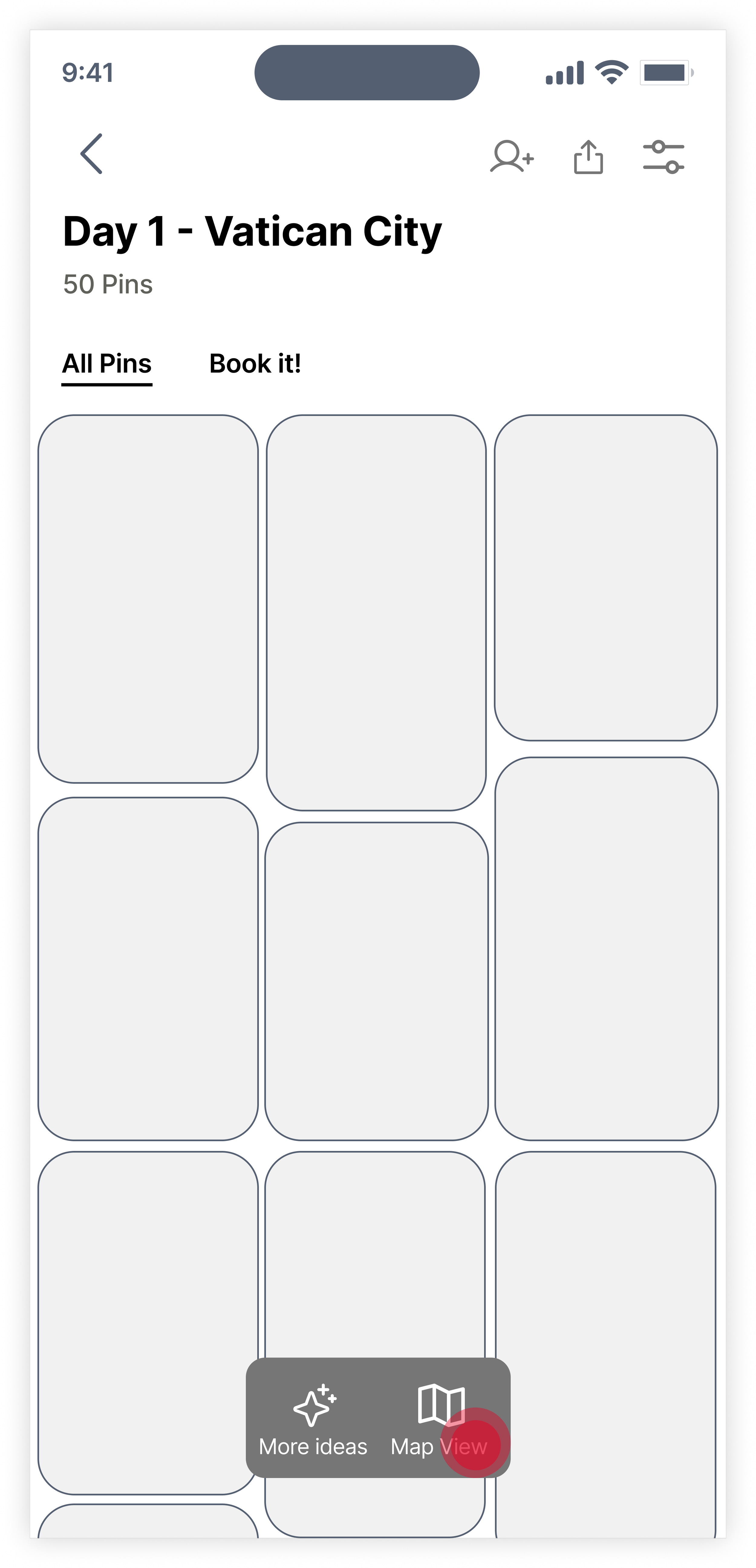
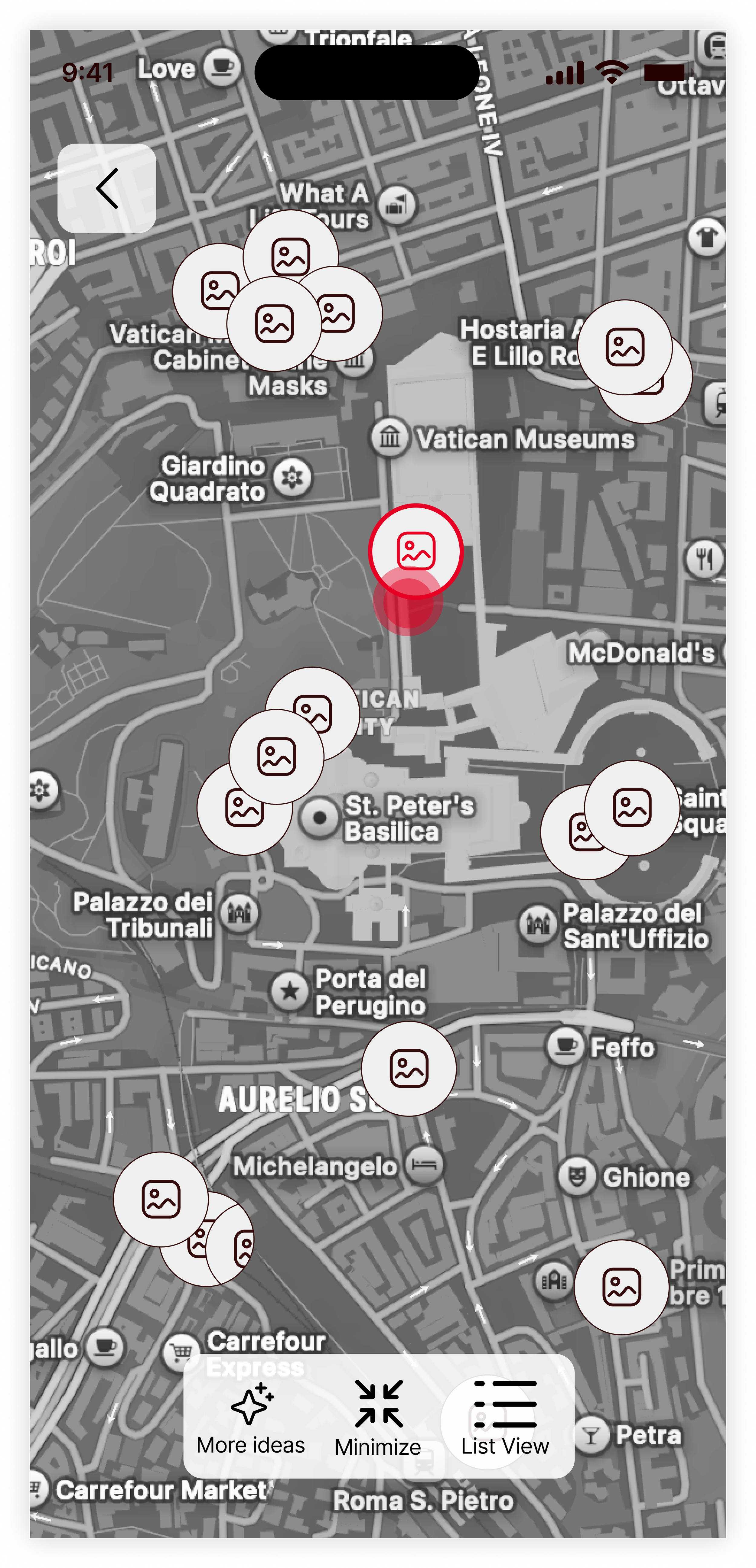
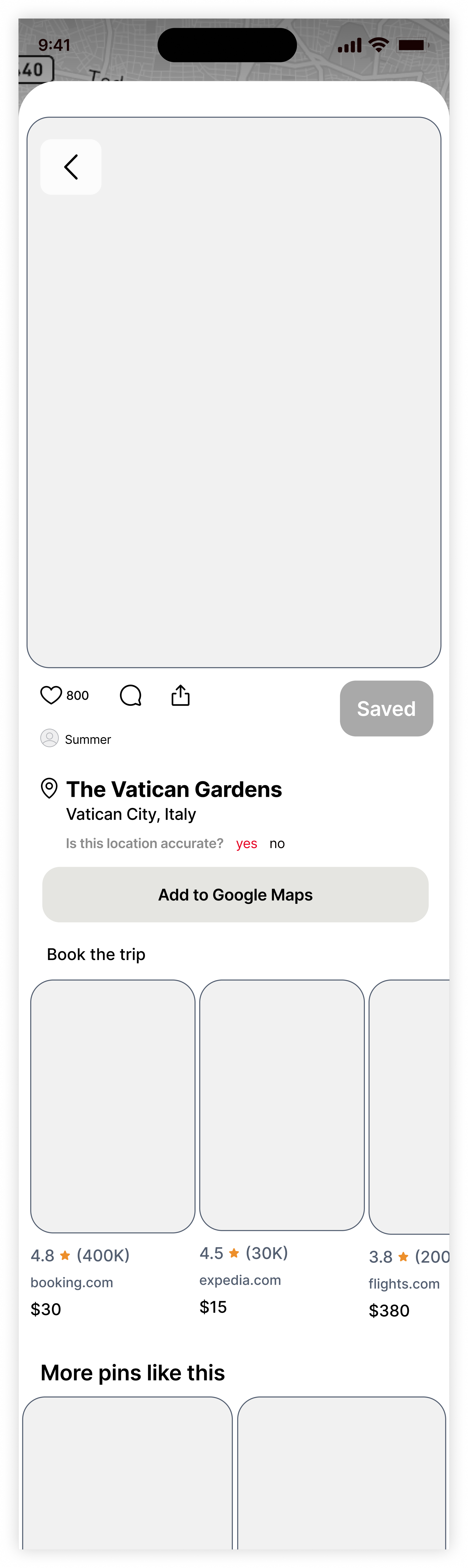
Prototype translations
I translated the wireframes into high-fidelity prototypes to bring the proposed experience to life. I began by defining how itineraries would function in the web view, then explored how users could discover and navigate those same itineraries through an interactive map view.
USER TESTING + ITERATIONS
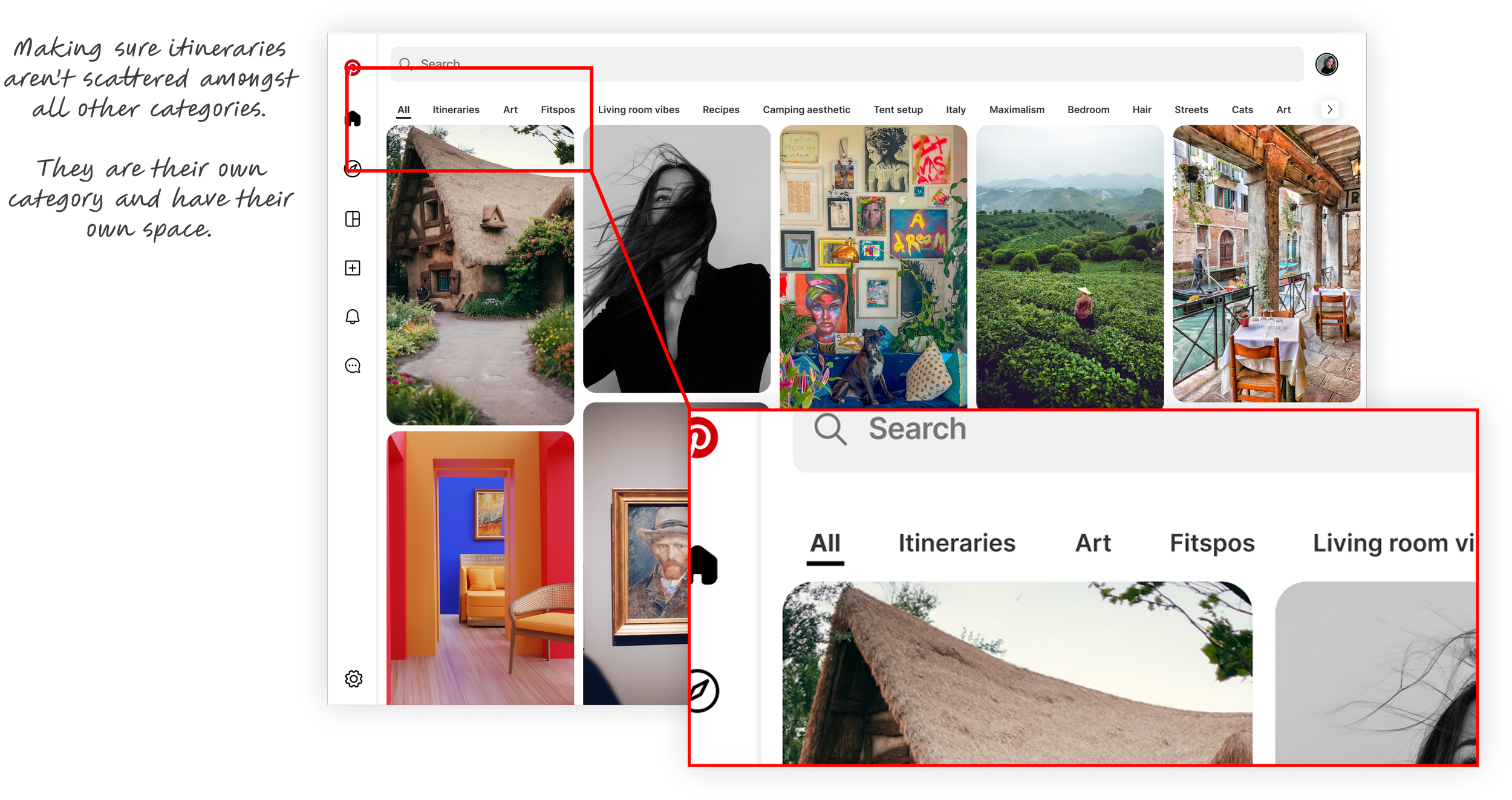
Testing revealed an important distinction between inspiration boards and travel itineraries. Having both types of boards discoverable through the same categories and entry points created potential confusion and made it unclear what users were looking at—or what they could do with it.
This also highlighted an opportunity for the AI to distinguish between the intent behind different boards. A board filled with haircut inspiration, for example, should not be treated the same way as a board containing geo-tagged travel destinations. My first iteration addressed this by making the “Create” flow explicitly differentiate between the two, while also separating inspiration boards and itineraries within the homepage categories.
Create a board vs. an itinerary
Final Mockups
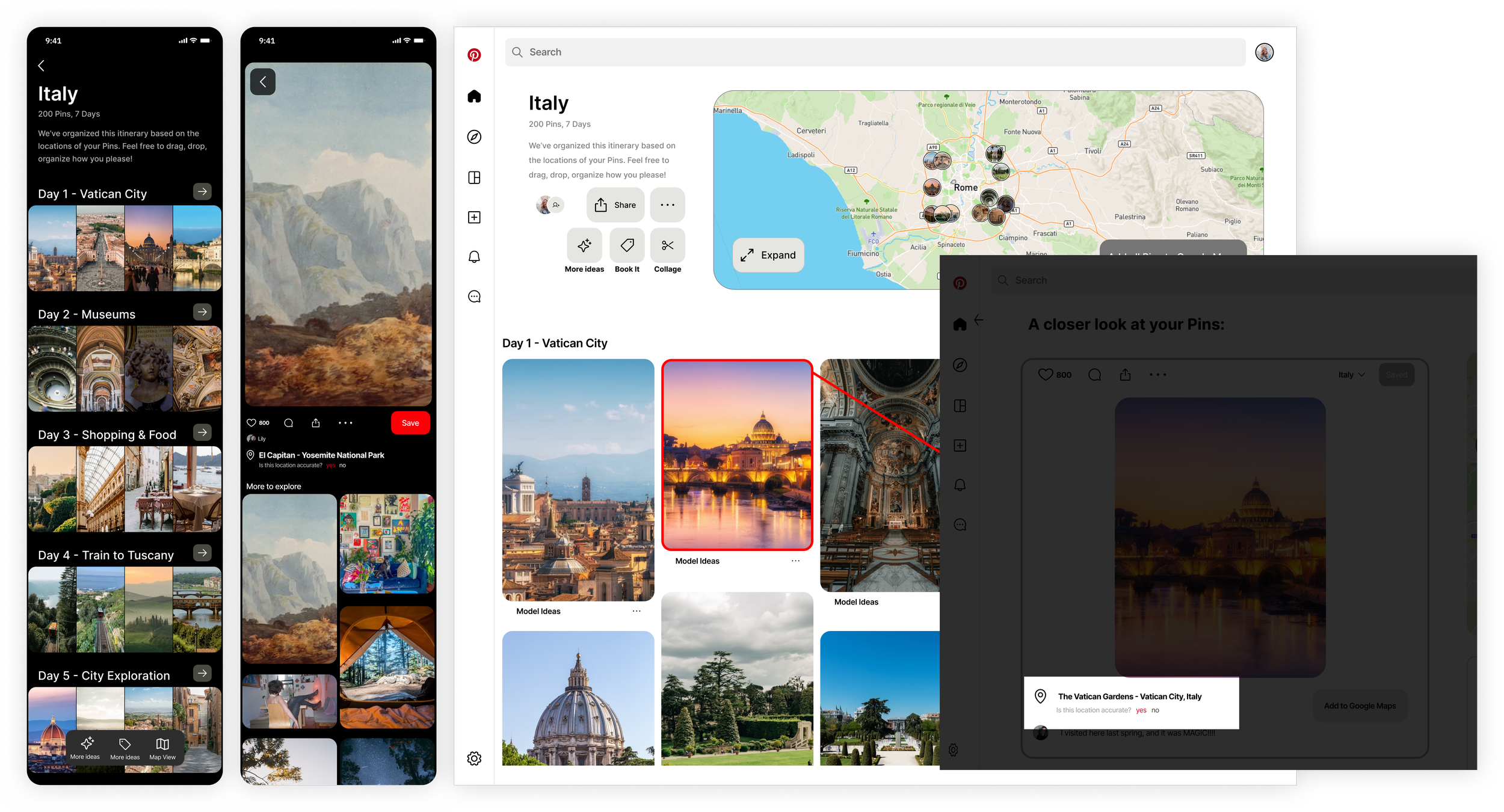
In my final mockups, I focused on refining the core experience: itinerary design, map view, and how automatic geo-tagging would function within Pin discovery and itinerary creation. While these mockups prioritize the core features of the MVP, the iterations explored in the previous section would carry forward as the product evolved into a fully developed experience. This would include dedicated categories for itineraries and clearer “Create” options to distinguish travel planning from traditional vision boards, reducing potential confusion while keeping Pinterest’s existing interface familiar.
Next Steps: Beyond the MVP
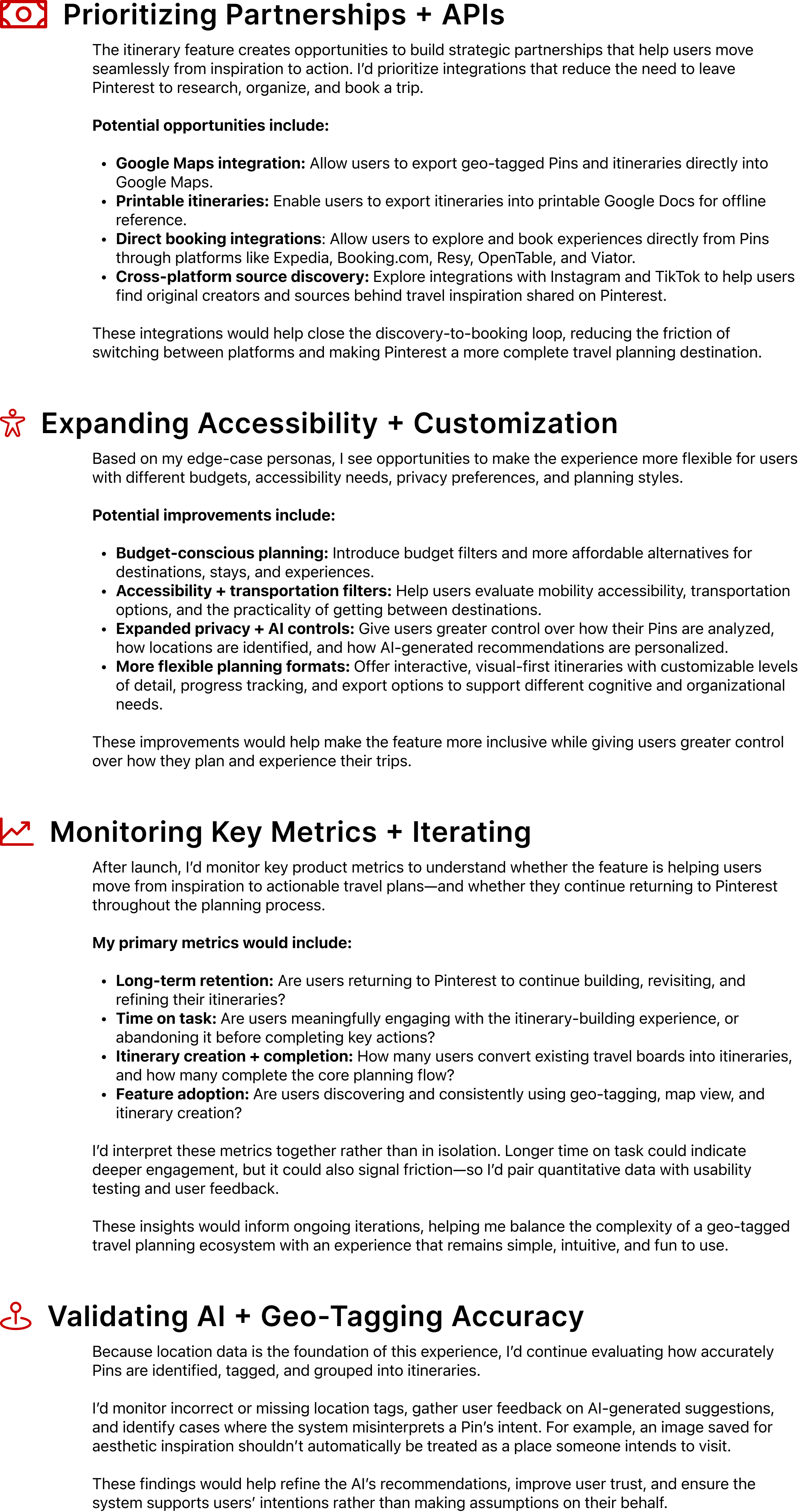
Launching this feature would be the starting point—not the finish line. As users begin interacting with Pinterest’s new travel planning ecosystem, I’d continuously monitor performance, identify friction points, and iterate based on real-world behavior. My long-term goal would be to build a feature that grows with users while keeping the experience intuitive, accessible, and enjoyable.
FINAL THOUGHTS
I’m proud of how I navigated this large-scale initiative independently, from early research and problem definition to feature prioritization and high-fidelity prototyping. Working solo, without a team of collaborators or dedicated research resources, challenged me to think strategically about how each feature would build on the next.
As the project evolved, it became clear that AI-generated itineraries alone wouldn’t solve the core problem. Manual and automated geo-tagging needed to come first, creating the foundation for a more connected, visual-first planning experience. Recognizing these dependencies required me to step back, revisit my assumptions, and approach the product as an interconnected ecosystem rather than a collection of standalone features.
What started as an ambitious idea became a mammoth project that pushed me to think beyond the initial concept and consider how the experience could realistically fit into Pinterest’s existing product. Even working independently from my desk, I was able to turn desk research into a strategic product vision grounded in user needs, thoughtful feature prioritization, and a clear path for future iteration.
I’m proud of what I was able to accomplish independently, and this project reinforced the importance of research-driven decision-making, breaking complex problems into manageable steps, and designing with both the bigger picture and practical implementation in mind.